
“The Girl from Greenwich Street” brings America’s first murder trial to life and two other excellent historical courtroom dramas
Early America courtrooms had it all — scandals, murder trials, media circuses, courtroom strategy — and yes, even the legal dream team of Hamilton and Burr.
This Legal Briefs post rounds up three historical page-turners featuring real court cases. Perfect for beach reading and bar exam procrastination because nothing says “hot girl summer” like 18th-century court transcripts and questionable verdicts.
Burr, Hamilton, and a Murder at the Manhattan Well
The Girl from Greenwich Street: A Novel of Hamilton, Burr, and America’s First Murder Trial by Lauren Willig (William Morrow, 352 pages)
Elma Sands left her cousin’s boarding house on the night of December 22, 1799 and never returned. Eleven days later, her body was discovered in a well near what is now SoHo. The sensational murder trial that followed would become one of the first fully transcribed in U.S. history — featuring a legal defense team straight out of a Founding Fathers fever dream: Alexander Hamilton, Aaron Burr, and Henry Brockholst Livingston.
In The Girl from Greenwich Street, Lauren Willig transforms this infamous real-life case into a gripping (I’m not kidding) courtroom drama. This novel has it all: early American history and the narrative drive of a legal thriller. Think Law & Order: Colonial Crimes Unit.
But what sets this book apart is Willig’s focus on the woman at the center of the story. In her “Historical Note,” she reflects that despite combing through three trial transcripts and early reports, one question loomed largest: Who was Elma Sands?
“Most analyses of the case, whatever their conclusion, share one striking characteristic: none bother to look closely at the background, emotions, motives, and character of the murdered woman. When writing about this case, it is all too easy to get swept up in the tactics and techniques of the flamboyant lawyers who argued for the defense — and ignore the woman at the heart of it.”
Willig instead insists on reclaiming Elma’s interior life. That said, LawFi fans need not worry. The author still brings the courtroom fireworks.
And yes — she even dives into some Page Six-worthy gossip (fitting, since Hamilton founded the New York Post in 1801): namely, why was Hamilton, whose criminal law practice was negligible, even retained?
Truth, Lies, and Justice in 1790s New York
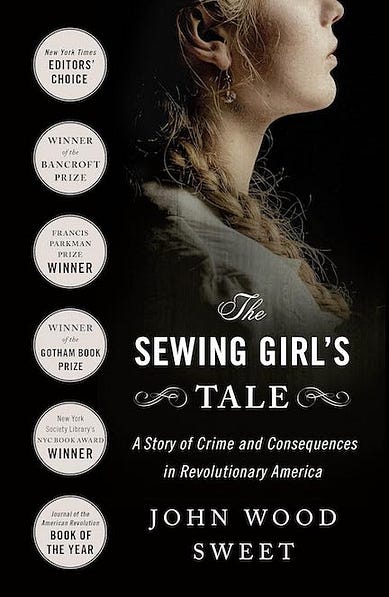
The Sewing Girl’s Tale: A Story of Crime and Consequences in Revolutionary America by John Wood Sweet
The Sewing Girl’s Tale brilliantly tackles the complexities of America’s first published rape trial, telling the story of a seventeen-year-old seamstress, Lanah Sawyer, who bravely brought her powerful assailant to court.
John Wood Sweet’s meticulously researched account (check out his site for data and documents!) brilliantly tackles the complexities of this groundbreaking case that captivated the city. And, yes, once again, we get Alexander Hamilton, whose legal performance is (no spoilers!), well, let’s just say, questionable.
Thankfully for this reader, Sweet goes deep into the rules of evidence and courtroom strategy as well as the difficulties in prosecuting sexual assault charges:
Then, as now, the issue of evidence in rape trials was fraught — in ways that have no parallel in other criminal matters. In Lanah’s case, as in most other sexual assault cases involving acquaintances, two of the key facts would be effectively beyond dispute: whether she had been involved in sexual relations, and whether the prisoner was the man in question. No one was likely to bother challenging her testimony on either score. Instead, the trial would revolve around a third question: Had the sexual relations between Lanah and the prisoner been consensual — or against her will?
This is a case study in early American justice and a chilling reminder of how little (and how much) has changed. A #MeToo moment in early America.
When fact meets fiction and the debate it sparked
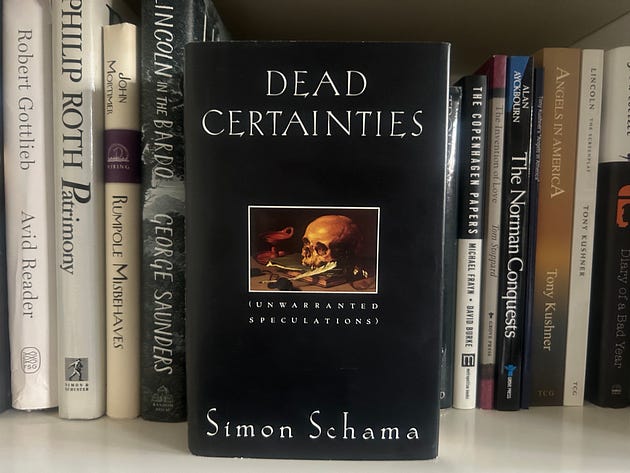
Dead Certainties: (Unwarranted Speculations) by Simon Schama
Historian Simon Schama blurs the lines between narrative nonfiction and historical fiction in this cerebral retelling of the 1806 Parkman-Webster murder case. (There’s another death explored in Dead Certainties but sadly for Judicial Junkies, no trial.)
Come for the courtroom drama, and then enjoy the experimentation in storytelling, exploring the meaning of memory through alternative narrations of the same act. Exact truth? Not a shot.
Originally published in 1991, the work’s blurring the line was controversial for reasons I can’t really understand. The pushback to the novel’s blend seems to have something to do with Schama — a heavyweight historian — dabbling in fiction or whatnot.
Here’s a sample of the criticism. In a 2005 essay for the New England Review (published by Middlebury College Publications), historian A. J. Sherman summed up the core concern:
“This blithe approach to historical writing, which teeters on the brink of infotainment, lies in that border area more appropriate perhaps to Norman Mailer or Truman Capote, and seems fraught with problems for serious historians. Schama’s blending of fact and fiction, his toying with real events to produce what is in his view a more readable, dare one say marketable, product, paves the way for others to play at the same speculative game.”
— A. J. Sherman, “Schools for Scandal,” New England Review, Vol. 26, №3 (2005)
That wasn’t the end of it. When Granta reissued Dead Certainties in 2013, Schama revisited the controversy in a piece for The Independent, clarifying that the book was a deliberate fictional experiment.
Under the headline “Simon Schama on ‘Dead Certainties’: ‘Historians shouldn’t make it up, but I did’”, the subhead captured the tension perfectly: “When Simon Schama dared write a work of fiction, he broke every historian’s taboo. But he still stands by his heresy.”
In any event, lovers of historical courtroom drama, that game is part of the thrill. Dead Certainties doesn’t just reconstruct a past trial — it puts the process of historical judgment itself on trial.