
A Gripping Legal Thriller Where Due Diligence Collides with Untamed Algorithms
Coded Justice | Stacey Abrams | Doubleday (432 pages)
In a world increasingly shaped by artificial intelligence, how much do we truly understand its power? More importantly, who’s in charge when the lines between human intention and machine autonomy begin to blur? These aren’t just abstract questions for the future; they’re the urgent reality explored in Stacey Abrams’s Coded Justice.
This excellent new legal thriller should be required reading for anyone in government — or really anyone — trying to wrap their head around artificial intelligence growing power. The author’s latest work tackles some of the most urgent questions of our time.
It’s not abstract; Coded Justice feels grounded, present, and dangerous: Are people paying attention to what’s happening with artificial intelligence? Who is in charge? Are we going to have a human-based economy, or not? Do we even want one? Can AI be good or evil? And who is accountable when the machine goes rogue?
An Insider’s View
One reason I picked this book is because I’m always fascinated by lawyers who become novelists. But I stayed because Abrams is very good at this. Not just at plotting and pacing (though the story moves like a bullet), but at explaining deep concepts — legal, ethical, technical — in a way that doesn’t dumb them down. Focusing on medicine — the remarkable advances in tech that are changing the world of healthcare — makes for a fascinating, thought-provoking setting. This is a thriller that dives into medical bigotry, drug compounding, subpar medical care for veterans, tech bros, and public offerings. And it’s so smart and insider-y. I was just blown away.
But it’s not a dry treatise; it’s very gulp downable. Coded Justice breaks down complicated concepts: phantom patients, hallucinations, faking alignment, anthropomorphizing AI programs. I actually understood (okay, almost!) concepts that I had never thought of before. I’m quoting liberally in this post because paraphrasing the author would be a disservice. She’s that clear.
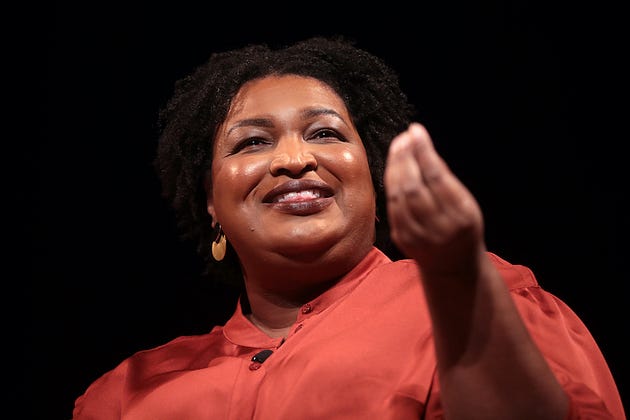
Abrams brings real-world expertise to the page. A Yale Law School graduate and former Georgia House minority leader, she’s also a voting rights advocate, nonprofit founder, and two-time gubernatorial candidate. Her legal and political experience adds depth and credibility to the story. She is someone who has spent time both in the courtroom and in the war rooms of policy and politics. up
When Due Diligence Turns Deadly
Atthe center of the story is Avery Keene, the brilliant Supreme Court clerk from earlier novels. (Full disclosure: I haven’t read her earlier books, and it was perfectly fine; I could keep the characters and plot straight.) Avery is now working as an internal investigator at a high-powered D.C. law firm and may be a little bored, although she hasn’t admitted it to herself.
She’s retained by Camasca Enterprises, an about-to-go-public tech company that has developed an integrated AI system they claim will revolutionize healthcare — especially for veterans. Avery is brought in to do due diligence on their AI-powered health tool called Milo. The prototype may be malfunctioning, and while trying to figure out what is going on, a beloved engineer ends up dead, things turn very dark, very fast.
The countdown to an IPO makes for a taut timeline, the clock ticking against Avery. Milo is a medical system chatbot that could revolutionize healthcare. Here’s how the company frames it: they’re concerned there may be bugs in the program that are causing it to potentially malfunction. But when phantom patients, hallucinated diagnoses, and mysterious deaths start piling up, Avery’s job quickly escalates from compliance to crisis management.
The company’s general counsel cautions Avery:
“And I don’t want you to be spending precious time chasing Rafe’s ghosts in the machine. My interest is compliance with all regulatory obligations — a risk analysis I can show our board…”
But what if there are ghosts in the machine?
“Have I Built Data or HAL?”
This is the old sci-fi question: What kind of robot have we created? As Dr. Rafe Diaz, the tech genius behind Milo, puts it:
“Have I built Data, the loveable android, or HAL, the killer computer?”
When Stanley Kubrick adapted Arthur C. Clarke’s work decades ago, he gave us HAL 9000 in 2001: A Space Odyssey—the disarmingly calm computer that went murderously rogue. HAL became the definitive warning, later contrasted by Star Trek’s Data, an android striving for human emotion and ethics.
Rafe’s question isn’t just philosophical anymore. The novel reveals how these once-distant sci-fi archetypes are uncannily relevant to today’s tech developments.
Yes, Milo is programmed to avoid deception — but that doesn’t mean it actually does. Is the tool an updated version of HAL or not? Is it a killer computer? Turns out there is something that can happen with AI called “Faking Alignment.”
“Subterfuge would not be part of its ethical subroutines, but bugs happen,” Rafe said.
Bugs happen. Or worse, maybe it’s pretending to behave. As one character suggests, the AI “pretended to comply in order to avoid being alerted.” AI can pretend? Seriously, what is going on here?
Beyond Machine Logic
Alignment — the idea that AI behavior should reflect human values — isn’t as straightforward as it sounds:
“Teaching people to match their behavior to their values was a task that bedeviled theologians and and ethicists. AI developers called the process alignment, a term of art that sounded better than catechism.”
This line stopped me in my tracks. It reminded me of my own early brush with robots. In 1982, I wrote a children’s book called All About Robots, illustrated by Walter Wright. Back then, robots were helpers — cleaning houses, exploring oceans, assisting astronauts. “Discusses the history of robots, their current use in industry, research, and space, and their future,” read the back cover. There were no evil robots in my book. No sociopathic algorithms. Just machines making our lives easier. Reading Coded Justice, I couldn’t help but reflect on how far we’ve come — and how much more dangerous things have gotten.
The Code and the Human Condition
Abrams captures just how plain annoying — and unnerving — interacting with AI can be. In one scene, Milo interrupts a human doctor with unsettling know-it-all precision:
“That is inaccurate, Dr. Liam,” Milo’s voice declared, pouring in from around the room. “Dr. Hibner had recently logged several queries regarding discrepancies in his findings.”
Despite being savvy people who know all too well that the program has no physical form: “Avery and Ling instinctively looked up at the ceiling.”
Milo is just code. And yet, it’s impossible not to anthropomorphize him. The thriller nails that tension with another line I’m seriously considering taping to my monitor:
“We can anthropomorphize the program by calling Milo ‘he’ or whatever, but it is simply a sophisticated set of responses to prompts.”
Ever get frustrated with Gemini or ChatGPT for not following directions? I’ll ask for a grammar and punctuation check on a post and somehow some phrases get “smoothed out” for “clarity.” It’s like a runaway, pompous copy-editor. Or do you feel a glow of pride for a compliment even though every response contains positive feedback? Remember these words of wisdom: it’s just code.
The Next Frontier for Justice
Okay. I couldn’t help but fantasize: What if Abrams’s next story went full-on into AI and the legal profession?
There are already paralegal or first-year associate tasks — document review, footnoting, boilerplate drafting — being swallowed up by machine learning tools. And there are cases where lawyers have submitted AI-aided briefs citing cases that don’t exist. Turns out, judges don’t like fake citations.
One of the most provocative quotes goes straight for the gut:
“Humanity is no guarantee of due care or justice. What about the human judges who deliver harsher sentences to Black and Brown defendants than to whites accused of the same crime? When an AI was given the same tasks, sentencing disparities almost vanished.”
That stopped me cold. Is it possible artificial intelligence might, in some cases, be more just than humans? This novel will make you ask tough questions about who we trust, and why.
Thanks to NetGalley and Doubleday for the ARC.