
Gabriel Urza doesn’t just give us a legal thriller; he gives us a raw, honest window into the human cost of justice
The Silver State | Gabriel Urza | Algonquin Press (304 pages)
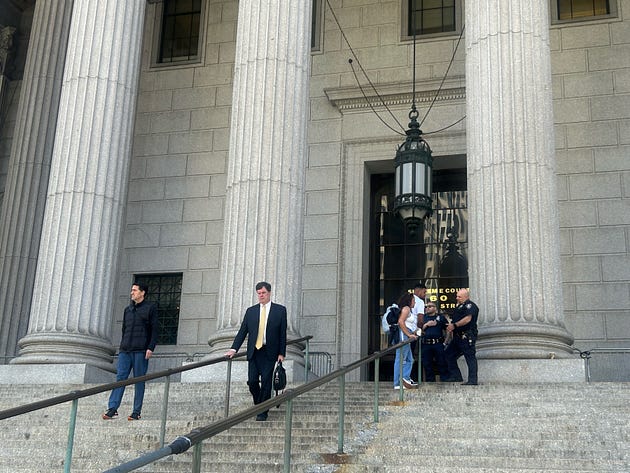
When public defender Santi Elcano, the protagonist of The Silver State, takes his wife, Sarah, on a tour of Reno’s stately neoclassical county courthouse, he doesn’t admire the beautiful architecture. Or think about how it famously facilitated quickie divorces for celebrities like Jack Dempsey, Arthur Miller, and Rita Hayworth.
Santi sees ghosts. He sees the spot where a prosecutor shot himself on the steps — the second District Attorney to commit suicide during his time in the office. He knows four defense attorneys who’ve tried to do the same and failed. As Santi observes with his characteristic dark humor, “Prosecutors just seem to be better at it.”
Forget Evidence 101, Criminal Procedure and Trial Advocacy. If you’re truly considering a career in criminal defense work, or just want an unvarnished look at the legal system from the trenches, you need to read Gabriel Urza’s riveting new novel,
Urza, a former public defender himself, unflinchingly pulls back the curtain on the nitty-gritty, often heartbreaking realities of defending the accused. While the intricate capital death penalty plot keeps you hooked — seriously, hooked — the true mastery of The Silver State lies in its nuanced and profoundly psychological portrayal of a public defender’s life.
The cases that haunt
Ifyou’re looking for a legal thriller that truly immerses you in the internal world of a lawyer constantly grappling with the uncertainty of his clients’ fates, The Silver State is an unforgettable read. Urza’s depiction of Santi Elcano’s interior life is as honest and accurate as anything I’ve ever read on criminal lawyers.
The novel’s emotional core lies in Santi’s past and present entanglement with a high-stakes capital murder case. Years prior, Santi and his mentor C.J. defended Michael Atwood, a man convicted of the sensationalized, CNN-covered murder of a young mother. Now, eight years later, with Atwood on death row, Santi receives a letter from his former client requesting a meeting.
This forces Santi to revisit the harrowing case and confront his lingering doubts: “No one wants to believe that Michael Atwood is in prison only because C.J. and I failed him.” Urza masterfully maintains the ambiguity surrounding Atwood’s guilt, keeping readers on edge and prompting reflection on the elusiveness of justice.
I devour every John Grisham book the day it’s released. I love blockbuster legal thrillers — fast-paced, streamlined, and always leading to a big, climactic end. Urza’s novel breaks from that formula. He weaves his experience through action, dialogue, and the legal thriller plot itself. It’s a slow burn, a long wind-up, but it, too, builds to a climactic end, with a gravitas that feels earned.
And it manages to be as cinematic as a Scott Turow or John Grisham at their best; this novel takes the luxury of time, more akin to a compelling streaming series. But one you will binge.
Beyond Santi’s personal journey, The Silver State serves as a powerful portrait of challenges within our criminal justice system. Drawing on his boots-on-the-ground professional background, Urza subtly questions systemic failures, highlighting resource inequality and the human cost borne by all participants — defendants, victims, and the dedicated, often overwhelmed, legal professionals.
The Numbers Game: Every Life a File
The portrayal of Santi’s first days as a public defender left me with a sense of just how overwhelming the job can be. In one early scene, Santi reflects on the eighty-three clients he’s been assigned:
“When I tallied up the years that all eighty-three of my clients might serve in prison, I learned that 1,411 years of human life resided in that cabinet.”
That is a mind-blowing statistic to even derive and what a way to think about the weight that public defenders carry. Santi quickly becomes adept at what he calls “bartering lives,” but he isn’t adept at forgetting the human costs.
Santi — unlike in many legal thrillers — has a packed caseload with more seemingly mundane charges like Shoplifting, Possession of Controlled Substances, DUIs. He spends his days wrangling clients, listening to voicemails, gathering information, calendaring, and making tough decisions about who to prioritize. Urza elevates these cases beyond mere caseload entries, revealing the individual stories and struggles behind them.
Urza’s insights into the weight carried by public defenders struck a personal chord. Right after law school, I worked pro bono on a capital defense team. After many post-conviction challenges in state and federal court, our client ultimately took a plea deal on the eve of a retrial. He’s still alive, serving time, and may come up for parole. I keep tabs on his case, wondering how he’s doing. I’ve set a Google Alert. It’s not just a file you close. And I think about the victim’s family, sitting stoically in court. There is no such thing as closure.
The Dirty Little Secret: The “Trial” is Usually Plan B
When most people think of lawyers, they envision courtroom drama — arguments, legal battles, and the climatic moment of a trial. The Silver State has all that yet powerfully reminds me that much of a defense attorney’s real work happens outside the courtroom.
In fact, after a full day of dealing with cases, and not going to trial, Santi’s mentor, C.J., succinctly states the reality:
“I hate to break it to you, but this is your job,” she said. “Haven’t you figured out the real work takes place out there? If you’re going to trial, usually it’s because someone is f**king up.”
This quote is a perfect encapsulation of the grind, the strategizing, and the constant assessment of risk that defines a public defender’s daily life. Trials are often a last resort, a sign that something has gone wrong in the negotiation or investigation phase.
Innocent Until Proven Guilty? Not So Much
There’s a brilliant — and yes, darkly funny — gut-punching scene where Santi talks with an ER nurse he’s going to start dating. She asks the classic question: “Have you ever had a client you thought was guilty?” Santi laughs, almost choking on his beer, and apologizes for his reaction:
“I’m sorry,” I said. “I’ve been doing this job for almost two years, and I don’t think I’ve had six clients who were actually innocent.”
It’s a stark revelation for anyone who believes in a justice system populated by purely innocent and purely guilty parties. Santi doesn’t have the luxury of idealism; he’s learned to live with the uncomfortable truth that many of his clients are guilty.
“Actually innocent” is often a unicorn. If you are in criminal defense work, you are going for “legally innocent.” This often means reaching into the toolbox of what most people think of as “loopholes,” such as due process violations like the prosecution failing to turn over exculpatory evidence, an illegal search and seizure, or even mistaken identity — all in pursuit of an acquittal.
The nurse asks the logical follow-up: “So, what exactly is that you do?” she asked finally. “I mean if they’re all innocent anyway…”
He doesn’t give his stock answer, that public defenders keep the system honest — “All that old Atticus Finch bullshit” — and answers honestly, he doesn’t know.
This moral ambiguity is something Urza explores so deeply that I found myself asking similar questions about the real-life criminal justice system.
Yes, everybody deserves representation in what is most likely the worst time of their lives, but why do certain people step up for such a quixotic quest? Prosecutors decide which cases to take to trial, and they don’t pursue “dogs” — they have winning records.
How to stay sane (or try to stay sane)
Santi quickly becomes adept at compartmentalizing his emotions to survive. He learns how to “hide away” his anxiety and stress, even from the high-profile nature of his Atwood case:
“But by then I figured out how to package the anxiety that my job had infected me with, how to hide it away for weeks or even months at a time.”
It’s a defense mechanism, a survival tactic in a system that is designed to ground you down. Santi goes fly fishing at the beautiful Pyramid Lake — “a silvery-green mirage.” He runs. He goes out for drinks with friends and other public defenders. Santi has a home life with a wife and young daughter. His wife has never seen him in court. That’s some pro-level compartmentalizing.
But I found myself wondering: how sustainable is this kind of compartmentalization? And at what cost does it come? Urza reveals the high personal costs — relationships strain, mental health is tested, and well-being takes a back seat to professional duty. Santi even smokes. Smokes for God’s sake.
The Silver State is a field manual for the emotional and ethical minefield of criminal defense, wrapped-up in some fiction.
It’s easy to romanticize lawyers as crusaders for justice, but Urza’s novel reminded me that the reality is far more complex. Public defenders are not only fighting for their clients — they’re fighting to stay sane in a system that often seems stacked against them.
Turns out, the real legal fiction is you can walk away clean.
My thanks to Algonquin Books for providing an Advanced Reader Copy of The Silver State.