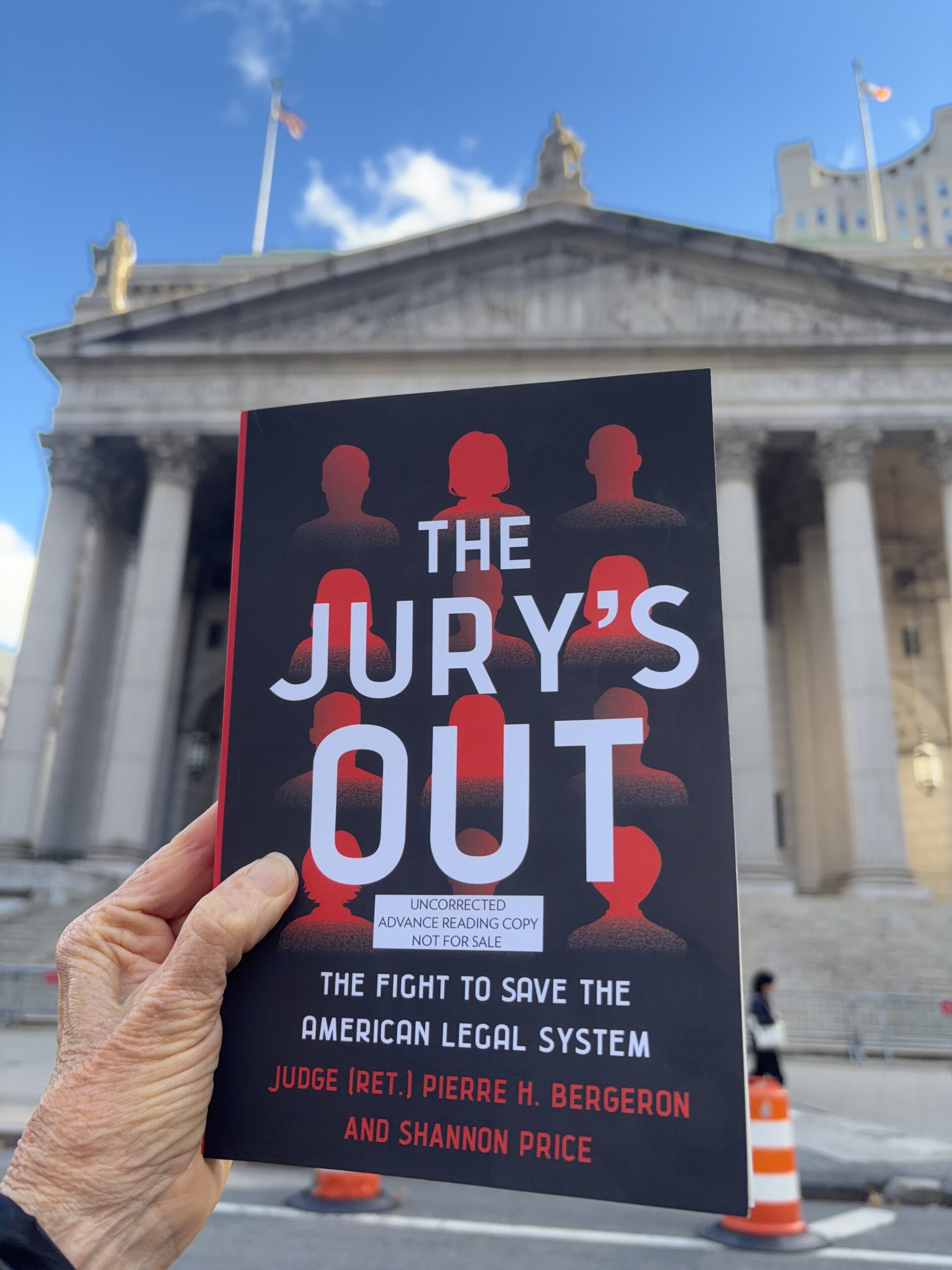
In “The Jury’s Out”, Pierre Bergeron and Shannon Price explore a legal system that has become remarkably good at avoiding jury trials
The Jury’s Out: The Fight to Save the American Legal System | Pierre H. Bergeron and Shannon Price | Cornell University Press (240 pages)
Overcrowded courts and runaway lawsuits have been staples of 60 Minutes segments and newspaper investigations for decades. The litigation crisis, like the poor, is always with us. When I was at Brooklyn Law School, my legendary torts professor, Jerome Leitner, an old-school lefty with a New Deal solution, had a simple suggestion: “Hire more judges.”
Instead, the legal system found cheaper ways to thin the docket, and the cheapest was keeping cases away from juries. The Jury’s Out shows what that looks like in Ohio’s trial courts. In 2022, roughly 415,000 civil cases and 490,000 criminal cases were filed. About 300 of the civil cases reached a jury, well south of 1 percent. Most criminal cases ended in pleas.
Retired Ohio appellate judge Pierre H. Bergeron and University of Kentucky law professor Shannon Price argue that we’ve gone much too far. They make their case through civil and criminal proceedings that are often as absorbing as true crime. Their prescription is straightforward: More cases should be decided by juries.
What Did You Expect?
On April 1, 2016, Mike Berkheimer slid into a booth at a Hamilton, Ohio, restaurant with his wife and some friends and ordered his usual: boneless chicken wings smothered in Parmesan garlic sauce. He cut one into three small pieces. On the third, something felt wrong in his throat. A needle-thin chicken bone, an inch and a half long, had torn a hole in his esophagus, flooding his chest with bacteria.
He survived two medically induced comas and a two-month hospital stay, but suffered permanent damage to his heart and lungs. A former hockey player and coach, he now carries portable oxygen when he leaves the house.
Berkheimer sued the restaurant, the chicken processor and the food distributor, expecting a jury to decide whether “boneless” means boneless. Instead, his case wound through eight years of motions, dismissals and appeals. In 2024, the Ohio Supreme Court ruled against him, 4–3, reasoning that bones are a natural part of chicken. He never got his day before a jury.
This is where my highlighter went wild. The three dissenting justices argued that reasonable consumer expectations were precisely the sort of question jurors should decide. “Jurors have likely eaten boneless wings,” they wrote. “Some will have fed boneless wings to their children, and jurors have common sense.” They called the majority’s reasoning “utter jabberwocky” and the decision “another nail in the coffin of the American jury system.”
Gone Fishing
The spine of The Jury’s Out, and the story that kept me turning pages, is the tragic case of Dean Gillispie, an Ohio man convicted of sexual assaults he insisted he didn’t commit. I found myself scribbling increasingly incredulous notes in the margins. “Unbelievable!” “WTF??!?”
I also kept warning myself not to give too much away, an odd precaution for nonfiction rather than the latest Michael Connelly thriller. There are plenty more twists and turns than I’ve revealed here.
Here’s one place where I scribbled, “Are you kidding me??? Two years after the assaults, Detective Scott Moore showed the three victims a photo lineup in which Gillispie’s picture was the largest, in the center, against a different background color than the other five. The lineup, the authors write, “all but circled Dean with a red marker.” Grand jury testimony also revealed that Moore “spoke to the victim while she was reviewing the photographs.” When one victim couldn’t pick anyone, he asked whether anyone “resembled” the perpetrator, and she settled on Dean.
His lawyers thought the evidence was weak. Then came the plea offer. Not thirty years, but thirty days. Not exactly the offer you’d expect from a state confident it had the right man. Gillispie refused. He wasn’t going to publicly call himself a rapist (fair point), and he believed an innocent man couldn’t be convicted. That’s where he went wrong. A jury convicted him, and he was sentenced to more than 50 years.
The jury’s initial vote was 8–4 for acquittal. The foreperson sent Judge Porter a note: “We appear to be hung.” Porter had other plans. “I have a fishing trip scheduled,” Gillispie recalls the judge saying, “and if you can’t reach a verdict, I’m going to miss my trip.” The judge ordered the jurors to continue deliberating and remain sequestered through the weekend if necessary. The message was unmistakable: Reach a verdict, and make it quick.
The jurors remained convinced they hadn’t heard the whole story. They hadn’t. After the verdict, Judge Porter did something the authors call “highly unorthodox.” He summoned Moore, the same detective, to talk to the jurors. Moore knew about the 8–4 vote. He told them Gillispie had a girlfriend who’d been raped and hinted that police had other weighty evidence of guilt that the jury never saw.
The postconviction proceedings are no less astonishing. And the surprises and twists keep coming. I will give away this much about Gillispie: During his 20 years in prison, Gillispie became an artist. He constructed fantastic elaborate miniature diners, gas stations and movie theaters from Popsicle sticks, cigarette-pack foil, soda cans and discarded tea bags. Other prisoners helped him scavenge materials. His work eventually appeared at MoMA PS1 in New York in Marking Time: Art in the Age of Mass Incarceration. I definitely recommended scrolling the exhibition checklist.
“I went in when I was twenty-four years old. I got out when I was forty-five. They destroyed my life,” Gillispie tells the authors. “This art is all I have to show for twenty years of my life being gone. I have nothing else.”
The Narrative in the Case File
At times I was reminded of Pamela Colloff’s terrific Catch the Devil: A True Story of Murder, Deception, and Injustice on the Gulf Coast, which also makes legal procedure as gripping as true crime. Colloff, a magazine writer, is the more accomplished stylist. Bergeron and Price are lawyers, and occasionally sound like it. But they know how to build suspense from a procedural ruling, a witness interview or a discovery that should have changed the course of a trial.
Bergeron’s involvement in Gillispie’s case gives the account particular immediacy. In 2012, he was an appellate lawyer at a global law firm when Mark Godsey of the Ohio Innocence Project called with a familiar opening: “I need a favor.” Godsey assured him the case wouldn’t take much time. Bergeron agreed to represent Gillispie pro bono in his appeal to the federal Sixth Circuit Court of Appeals, where the case was argued in June 2014. He describes himself as the “relief pitcher brought in to close out the game.”
It’s Expensive, and Nobody Wants to Pay
Bergeron and Price aren’t proposing to abolish plea bargaining or summary judgment. Their reforms are fairly modest: better jury pay, more representative juries, greater public scrutiny of the courts and better data on what actually happens to cases. The money seems a good place to start. Hamilton County, Ohio, pays jurors $19 a day. Mississippi and New Jersey pay $5. That’s 62 cents an hour for an eight-hour day. We celebrate jury service as a sacred civic duty, then pay people less than it costs to park at the courthouse. And we wonder why serving is a hardship.
Of course juries make mistakes. Bergeron cites research showing that judges disagree with jury verdicts about 15 percent of the time. But appellate courts reverse trial judges in 10 to 20 percent of cases. Judges aren’t infallible either, although they tend to be considerably better paid.
When the Bulwark Holds
Lately, Washington juries have shown a willingness to say no to federal prosecutors. In October, a grand jury refused to indict Cassidy Hutchinson over allegations arising from her testimony to the House January 6 committee. Another grand jury declined to indict Sean Charles Dunn on a felony charge for throwing a Subway sandwich at a federal agent. Prosecutors pursued a misdemeanor instead, and a trial jury acquitted him.
Grand juries and trial juries serve different functions, but both can check prosecutorial power. Bergeron and Price would like Americans to have more opportunities to exercise it.
The Fine Print: Thanks to Cornell University Press for the advance galley.