
Franklin’s “Great Black Hope” delivers literary firepower; Burke’s “The Note” is a twisty legal thriller
Great Black Hope | Robert Franklin | Simon & Schuster (320 pages); The Note | Alafair Burke | Knopf (304 pages).
Does everyone make bad choices in the Hamptons? Let me phrase the question: Does everyone actually get caught making those bad choice?
That’s the backdrop of these two highly recommended reads: Rob Franklin’s Great Black Hope and Alafair Burke’s The Note.
Both novels masterfully capture the dark underbelly of the storied Hamptons playground. And both novels begin with one bad choice — a cocaine bust in Great Black Hope, a petty prank in The Note — and spiral into high-stakes legal nightmares.
Of course, the big existential questions are there, I guess, like who gets charged, who gets punished, who gets protected.
But to me, the real common, crucial denominator? Both authors understand: the game-changing, pivotal dramatic moment often glossed over in LawFi: The proper selection of the right defense lawyer.
Franklin’s “Great Black Hope” — Legal Drama with a Literary Edge
The stakes in Great Black Hope are personal and political. The story follows David Smith called Smith), a queer Black Stanford graduate, as his life unravels after a cocaine possession arrest at a club in the Hamptons.
SIDEBAR: Both novels have David Smiths (actually, two in “Great Black Hope”). Amusingly, “The Note” even bemoans how hard it is to find the right David Smith on Google.
The bust is equal parts bad choice and bad luck — people do cocaine in Hamptons clubs all the time, after all — but Smith’s fallout is immediate.
His initial impulse is to stay quiet, liquidate his IRA, and retain a billboard lawyer, calling 1–800-GET-U-OFF.

Lawyer Shopping Like You’ve Never Seen It
Here’s where Franklin’s genius kicks in. The lawyer selection process is treated with the same intensity as a thriller’s second act. Fortunately, Smith’s good choice is combined with good luck.
Smith is blessed with a smart, supportive family that knows what’s important. In an initial family call, his mother side-steps an emotional autopsy — which they take to calling the arrest as “the incident.”
“The immediate concern,” she said, was “to retain a lawyer.”
Smith’s sister Nia is a 2L at Harvard Law, so no law license, but dispensing legal advice as well as consulting her professors for recommendations. Franklin’s grandmother, a criminal lawyer, had defended many similiar cases. Smith asks his Hampton friends, notably Carolyn, for referrals.
First up: Smith and his father meet via Zoom with Jordan Blackwell, a high-powered lawyer who drops the name of the renowned Harvard Professor Skip Gates, projects “aggressive competence” which put the family at ease. Blackwell said with “utter confidence” he’d get the “record sealed.”
The David Smiths are sold, but agree they should complete their due diligence and interview another lawyer.
At first, it’s a non-starter: “The second lawyer, James Walsh, had come on the recommendation of a friend of Carolyn’s from East Hampton AA; his sole qualification seemed to be the successful defense of a reality star of whom she hadn’t heard.”
Did I mention the book is very funny and observations dead-on?
Anyway, Franklin describes the lawyer as “endowed with a salesmanship better suited to the trade of used vehicles” and refuses to give an absolute guarantee on a favorable outcome (“I’m not a betting man”). But he calls the judge by her first name, shares that his uncle worked with her in the D.A.’s office with for decades, and she is “tough.” A different kind of name dropping.
After the call, the family held a debriefing session.
“[T]hey debated the merits of each: the hard power of the cool command of the law versus the soft and all the more insidious power of network — the answer was obvious.”
Go local. The rest of the book, to me, is basically whether they made the right call on the lawyer. Harrowing!
Zoom Therapy, Tabloid Pressure, and the Weight of Grief
Smith’s mandated recovery program journey includes hilariously useless Zoom group therapy, led by a therapist who utters “the beginning of the rest of your life” no fewer than six times in a two-minute speech.
This dubious recommendation from Walsh, Smith’s lawyer, immediately made me wonder about the lawyer’s judgement. Yet, Walsh persistently hammers home the critical importance of clean drug tests, perfect therapy attendance, and remaining trouble-free.
Compliance? Judges live for it.
The legal mess is just one layer. Smith is dealing with the gut-punch of the unexplained death of his beloved roommate, Elle. An investigation is on-going: was the cause of death drugs or murder? Elle happens to be the daughter of a legendary soul singer. So the tabloids are unrelenting and hounding Smith. So are investigators. Race, class, media, drugs, and justice — the book deals with all these hot topics deftly, vividly, and insightfully.
As someone obsessed with diagramming sentences, I found Franklin’s Great Black Hope a literary marvel. The author, a poet, crafts mean sentences and shows a keen sense of observation. (A character is described reading Proust by the pool — nice detail.) I kept highlighting passages again and again. And the semicolon and em dash usage? Masterful.
Deeming finance, tech, and real estate pedestrian, they dedicated their not insignificant faculties to careers at luxury brands and Chelsea galleries — and, with the rest of their considerable time, to the obsessive curation of their days. They seemed to live entirely by what looked best in retrospect; a picnic in the park was incomplete without a tuft of bundled peonies, a sketchbook casually strewn.”
No spoilers. You will have to read the wonderful prose yourself to see if the lawyer got Smith’s record expunged.
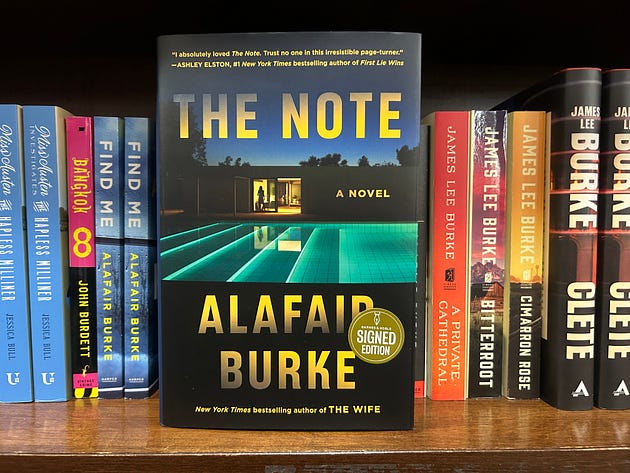
Burke’s The Note: From Parking Spat to Possible Murder
What begins as a Hampton’s girls weekend getaway unravels (yes, more unraveling! Plus, spiraling!) from the fallout from a seemingly trivial act — a note left on a stranger’s windshield following a parking spat.
Then the man who received the note — you guessed it, David Smith — goes missing. Longtime friends May, Lauren, and Kelsey find themselves at the center of a media storm and police investigation.
Spoiler Alert Following: Mostly About Legal Ethics
Ethics, Loyalty, and the Legal Gray Zone
Kelsey is facing misdemeanor charges for giving false statements to investigators but the investigation looks like it is leading to a murder charge. So no, it’s no joke.
Facing potential felony charges, Kelsey is savvy enough to know she needs a great lawyer. The friends discuss the fact that Kelsey was too rich to get a public defender but not rich enough retain a big-league lawyer to rush out to Southampton. Kelsey phones a criminal lawyer in Boston, who isn’t licensed to practice in New York (long story on that one).
The lawyer search is a work in progress and the arraignment is happening fast. The friends know just the lawyer: May Hanover— a former Brooklyn ADA and current law professor — who happens to be Kelsey’s closest friend.
“We’ll figure something out, but we were about to call to ask you — beg you if necessary — to represent Kelsey tomorrow at her court hearing.”
The office door slid open. Josh looked incredulous…
She shook her head and made a slashing gesture across her throat.”
The slash motion May made to her boyfriend Josh? It was because the court appearance would be a quagmire dealing with her messy friend group and a messier fact pattern.
It’s a move that raises serious ethical questions testing loyality to her friends and duty to the law. Burke doesn’t dive deep into the weeds of ethics — though with her résumé (Stanford Law, Ninth Circuit Court of Appeals clerkship, former prosecutor, current professor at Hofstra Law) you know she could.
Instead, she keeps the plot tight, the dialogue snappy, and the drama moving.
Still, if Burke had taken a detour into the ABA’s Model Rules of Professional Conduct on conflict of interests or candor toward the tribunal? I’d have followed her there with a highlighter and a beach chair.
But that’s not the vibe of The Note. The courtroom scenes work beautifully — May impresses the judge, despite the pain of a blister growing from heels that she hasn’t worn in years. The taut legal tension throughout the novel sits comfortably alongside the novel’s larger themes of friendship, expectations, and the long tail of bad choices.
Final Verdict: Two Unputdownable Hamptons Thrillers
If your Hamptons summer plans involve questionable decisions, at least have a good lawyer on speed dial — and one of these twisty, razor-sharp reads.
Thanks to Simon & Schuster and NetGalley for the Great Black Hope Arc.