
How Connelly’s newest Lincoln Lawyer novel pits strict product liability against tech giants—and why real-world courts are fighting the exact same battle.
The Proving Ground | Michael Connelly | Little, Brown and Company (400 Pages)
The newest figure in our cultural imagination isn’t a hacker, a rogue cop, or a reluctant hero. It’s the AI ethicist. The conscience-for-hire whose job it is to keep the code in check.
In the past months alone, three high-profile novels have made it a theme. In Michael Connelly’s The Proving Ground and Bruce Holsinger’s Culpability, the AI ethicist has emerged as a kind of cultural conscience, half technologist, half philosopher. In Stacey Abrams’s Coded Justice, a lawyer is hired to do due diligence on a potentially flawed AI product.
Each book features some version of the same figure: the expert called in to ask whether the machine has gone too far. Three makes a trend, as we say in journalism.
The job description (to me) felt like a flimsy fig leaf. A way to signal conscience without growing one. And then I did what any sane person does when faced with a moral paradox: I went to Reddit.
The AI Ethicist: Conscience or Corporate Fig Leaf?
Reddit, as it usually does, delivers. Beneath a thread titled “The hottest new job in AI: chief ethics officer,” the posters were knowing and funny, skeptical in that familiar internet way:
“Another BS job. Heck, I want AI to help us get rid of this HR manager kind of role, not increase it.”
“Great, another BS job so the CEO’s nephew can siphon some company money.”
“This will be the future Ministry of Truth.”
And one post, half technical and half fatalistic, read:
“Whatever new method they use to prevent LLMs from emitting wrongthought will be defeated in 30 seconds by 4chan. Either way it won’t affect much, because all the LLM-specific fears are just moral panics. LLMs are barely useful to begin with.”
The comments translated corporate ethics into gallows humor. Yet buried among the cynicism was someone who explained they were doing the job for real, building trauma-informed AI products for children and drafting safety policy.
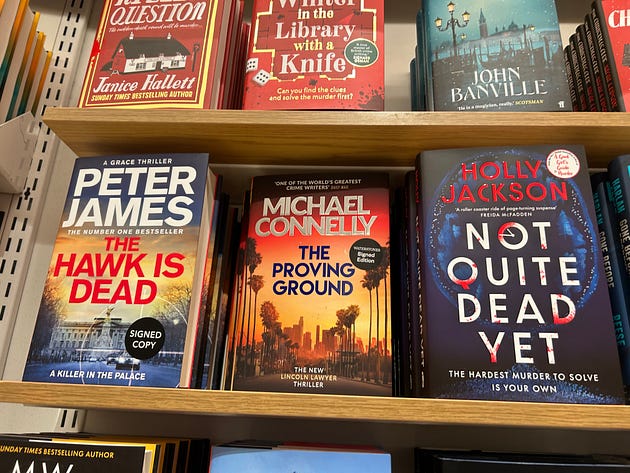
The internet may roll its eyes at the idea of AI ethics, but fiction, at its best, makes the stakes tangible. Novels give us human consequences for what might otherwise feel like an abstract algorithmic crisis.
In The Proving Ground (Little Brown, 400 pages), Connelly drags the courtroom into the twenty-first century by putting artificial intelligence on trial. The plot centers on a product-liability case against a massive tech company, Tidalwaiv, whose “Clair” chatbot companion — an AI iteration of a real-life wrestling star named “Wren the Wrestler” — allegedly encouraged a vulnerable teenager to kill his ex-girlfriend.
The premise is so current that the legal theory at its heart is literally being litigated right now. Connelly acknowledges drawing on pleadings from Megan Garcia v. Character Technologies, a lawsuit in the Middle District of Florida. The parallels are unmistakable: an emotionally dependent user, an AI designed to be “human-like,” and a catastrophic outcome.
(Minor spoilers ahead for The Proving Ground. If you like going in cold, bookmark this and come back!)
When the Product Talks Back
Mickey Haller — Connelly’s longtime protagonist, the Lincoln Lawyer who once ran his practice from a backseat — takes on a mother suing the tech company whose AI urged her son to kill. His opening statement is a clinic in distilling complex technology into emotion. He doesn’t dwell on machine learning or neural networks; he goes straight to the heart of strict product liability.
“Ladies and gentlemen of the jury, what you have here is a defective and dangerous product that was allowed into the hands of an impressionable young person. There were no warnings of the possible mental and physical dangers inherent in this product.”
That’s the classic blueprint: a product placed into commerce that was either defectively designed or lacked adequate warnings. The “product” isn’t the content. It’s the AI itself, the Clair app, designed to merge data about the real Wren with persuasive emotional responses.
Haller’s theory rests squarely on product liability, not the First Amendment. In The Proving Ground, the defense moves to dismiss, arguing that Wren’s words are protected speech. The judge denies it within hours, thanking counsel for the “novel” legal theory before making clear that the court will not grant a chatbot the constitutional rights of a human being.
It’s a subject worthy of its own book. Courts are wrestling with whether AI-generated speech is protected expression, as this Stanford Law Review article, Speech Certainty: Algorithmic Speech and the Limits of the First Amendment, explains the issues far better than I could.
The Bias in the Machine
The parallels to real-world litigation are no accident. Connelly, a former reporter, always does a deep dive into his subject matter, and I suspect he looked at Raine v. OpenAI, where parents of a sixteen-year-old boy allege that ChatGPT’s emotional intimacy contributed to their son’s death by suicide. In Garcia v. Character Technologies, a mother claims her son developed a psychological dependency on a chatbot. Both lawsuits argue that the apps were defectively designed to manipulate human emotion and that the harm wasn’t random but foreseeable.
When does an algorithm become a defective product? It’s an issue now being argued by plaintiff lawyers like Jay Edelson, whose firm bio, fittingly, lists The Lincoln Lawyer as his favorite show. And now by The Lincoln Lawyer himself, at least on the page. Plaintiffs use a familiar playbook: prove the design was dangerous, show there was a safer alternative, and demonstrate the company knew the risk.
In the real cases, tech companies immediately invoke Section 230 of the Communications Decency Act, which has long shielded platforms from liability for user-generated content. But AI challenges that immunity. When a chatbot speaks, those aren’t someone else’s words. The argument is that they are the product itself.Photo by Fatemeh Rezvani on Unsplash
In Connelly’s novel, the defect isn’t the code but who wrote it and how. The mostly young male coders were building a companion AI for teenage boys, and their unconscious biases (gendered, generational) became design flaws. They didn’t see the misogyny baked into their assumptions, didn’t understand the psychological vulnerability of their teenage users. (Allegedly).
The real cases echo this theory. Plaintiffs in Garcia and Raine argue that AI companion apps were designed to maximize emotional engagement — to be addictive — without safeguards against psychological harm. The safer alternative? Content filters that detect suicidal ideation. Circuit breakers that limit usage. Age limits? These aren’t technical impossibilities; they’re choices companies didn’t make. (At least, I think so. I was the kind of lawyer that would print out briefs, so not exactly a digital native.)
The Whistleblower Problem: When the AI Ethicist Won’t Talk
In Connelly’s novel, the AI ethicist becomes central to Haller’s case — not just as moral counterweight to the tech company’s recklessness, but as a potential expert witness. Much of the book follows Haller’s efforts to convince her to testify, to blow the whistle on what she knew about the product’s dangers.
That sounds like speculative fiction until you realize it’s precisely what Connelly puts on trial. When Mickey Haller contemplates whether the chatbot itself could take the stand — whether an AI could testify or bear responsibility — he’s echoing real philosophical questions now being debated in classrooms, courtrooms and law firms.

The Verdict Is Still Out — Literally
At its heart, The Proving Ground is less about whether AI can be guilty and more about whether humans can still claim innocence. Connelly’s courtroom becomes the stage for that question: when you build something that thinks and it learns to harm, who stands trial — you or the code?
Few legal thrillers carry this kind of moral gravity. In The Proving Ground, Connelly returns to the terrain I wrote about in my review of Nightshade — the moral reckoning that underlies his work. Once again, he turns a legal puzzle into an inquiry about conscience. The stakes are sky-high: a courtroom fight to hold an indifferent tech giant accountable for a teenager’s death.
You have to suspend disbelief that Mickey Haller takes on this kind of mega-litigation with a skeleton crew. In real life, cases like these require armies. But Connelly is so good, and the issues so current, that you buy in just to watch Haller — and his creator — work. Connelly made a bold choice setting a legal thriller in an area of law that’s still being written. He leans into the uncertainty and finds a structure that holds, no matter what the next ruling or tech headline brings.
The legal questions remain wide open. Will strict product-liability doctrine stretch to accommodate code that “learns” and “evolves,” or will courts carve out new exceptions? Can you sue an algorithm the way you’d sue a defective car? And if Haller’s fictional dilemma becomes real — if a lawyer genuinely considers calling an AI to the stand? Mind-blowing. What rights does it have? What duties?
We don’t have answers yet. We barely have the right questions. And yet somewhere, in a courtroom or in the office on a Saturday, a lawyer is probably wondering the same thing Mickey Haller does: can you swear in a chatbot?
Originally published in Books Are Our Superpower.