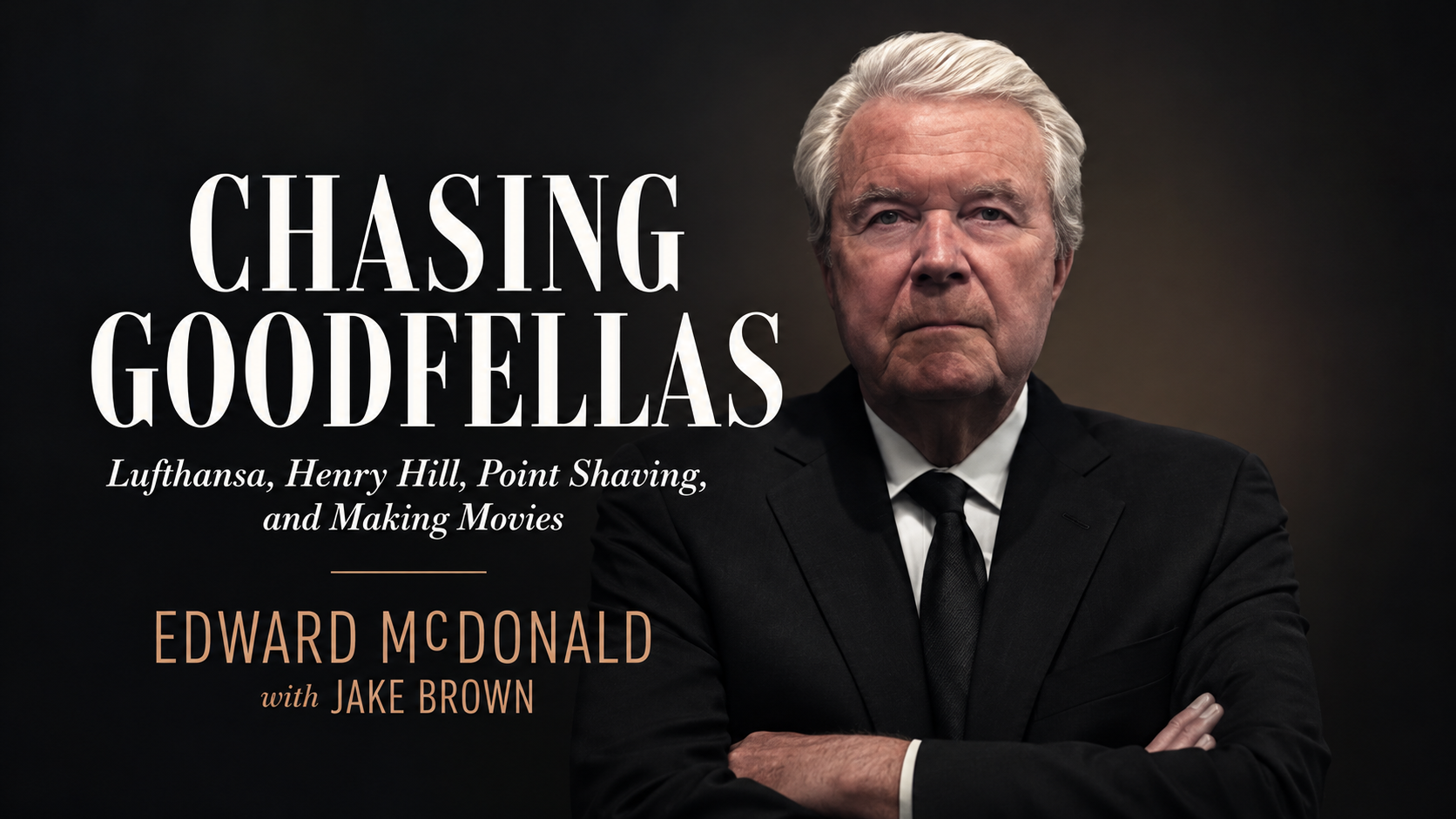
Edward McDonald’s “Chasing Goodfellas” revisits organized crime, courtroom battles and the making of a Hollywood classic. The best scenes didn’t require a screenplay.
Chasing Goodfellas: Lufthansa, Henry Hill, Point Shaving, and Making Movies | Edward McDonald with Jake Brown | Post Hill Press (352 pages)
Former federal prosecutor Edward McDonald had an unusual role in Martin Scorsese’s Goodfellas. He played himself. And he delivered a line people still ask him about: “Don’t give me the babe in the woods routine, Karen.”
In Chasing Goodfellas: Lufthansa, Henry Hill, Point Shaving, and Making Movies, McDonald, writing with Jake Brown, reveals that the line was entirely improvised. In fact, all the dialogue in the six takes of the scene was improvised. When Lorraine Bracco, playing Henry Hill’s wife, protested her innocence, McDonald simply reacted instinctively. He had used the expression before, both with witnesses who denied wrongdoing and in court. He couldn’t remember exactly how it came to him during filming. It was just something he said when someone started, as he puts it, to “cry the blues.”
The fix was in. Sort of.
McDonald has plenty more to say about the making of Goodfellas and the real criminals whose exploits inspired the movie, including the infamous 1978 Lufthansa heist, when a crew attributed to Jimmy “The Gent” Burke stole nearly $6 million in cash and jewels from a cargo terminal at JFK Airport. But the episode that caught my attention was the Boston College point-shaving scandal, a criminal enterprise that turned out to be part high-stakes gambling operation and part comedy of errors.
I knew the outlines of the scandal but not much more. During the 1978–79 basketball season, mob associates recruited Boston College players to manipulate the margins of games so gamblers could profit from bets against the point spread. Henry Hill, the mobster whose life story Goodfellas would eventually tell, helped bring the operation to Burke and his associates.
The trouble was that fixing basketball games proved harder than the conspirators anticipated. Players didn’t always deliver the desired results. Some weren’t even in on the scheme. After one disastrous game, Burke was so furious about his losses that he put his foot through his television screen.
Hill, who had helped arrange the fix, was equally exasperated. He called one of the players with a reminder of what could happen if the mob continued losing money: “You can’t play basketball with broken arms.”
It’s the sort of dialogue that makes you wish McDonald had included more of it. His prose is straightforward and specific, which is what you would expect from a lawyer who likes his facts. And mostly clean of expletives. Before relaying Hill’s account of the conspiracy, McDonald announces that he will leave out the “fuckins” and “motherfuckas,” so I mentally put them back in as I read.
The Witness Takes the Stand
The best material comes when Hill becomes a government witness and takes the stand against Burke and other defendants. By then, he was already turning his criminal past into a commercial enterprise.
Hill admitted that Sports Illustrated had paid him $10,000 and Simon & Schuster had given him a $145,000 advance for his life story, though he had received $100,000 of it. I had encountered Hill’s entrepreneurial streak myself. In 1992, I wrote a story for Spy magazine about his efforts to peddle stories in Hollywood, titled “Breaking a Leg! Can Wise Guy Henry Hill Make a Killing in Show Business?”
That talent for cashing in on his criminal past was precisely what the defense hoped to use against him. But McDonald saw the payments as a double-edged sword, one that cut more sharply against the defense. Surely a man commanding that kind of money had been involved with important criminals and serious crimes.
A Lawyer the Prosecutor Wanted to Keep
Burke’s defense lawyer, Michael Coiro, had previously received confidential information from Hill, giving McDonald strong grounds to seek his disqualification. But McDonald had seen Coiro in action and considered him such a poor trial lawyer that he decided to keep him.
McDonald describes the shiny suits, slicked-back hair and swagger, along with a cross-examination technique that consisted largely of shouting the same question at witnesses: “So you’re a liar, right?” McDonald concluded that Coiro’s presence would help the prosecution more than his removal.
There’s a serious legal question buried in this amusing portrait. In a footnote, McDonald acknowledges that, under today’s law, his failure to alert the court to such a conflict would almost certainly create grounds for reversing a conviction. It’s a fascinating admission from a prosecutor looking back at a tactical decision that worked to his advantage.
Meanwhile, Coiro kept trying to rattle Hill. At one point, the lawyer expressed disbelief that Burke could have bet $50,000 on a single Boston College game. Hill responded by lifting his hands above his head, wiggling his fingers and lowering his arms as though money were falling from the sky.
“In them days, $50,000 was confetti.”
The Prosecutor’s Version
Chasing Goodfellas is not a literary memoir. McDonald is more interested in explaining how cases were assembled and tried than in polishing every anecdote. He walks readers through witness preparation, evidentiary disputes and pretrial motions, including arguments over whether one defendant’s statements could be used against another.
For some readers, the procedural detail may slow things down. For litigators and courtroom junkies, it’s part of the attraction. Pretrial motion practice in all its glory!
McDonald had a front-row seat to some extraordinary criminal history, and his account is especially good when he shows how prosecutors make decisions that never become part of the public drama of a trial. Which witnesses can be trusted? Which damaging facts should be confronted rather than concealed? And when might the defense lawyer be doing more harm to his client than the prosecution ever could?
For all his attention to legal detail, McDonald knows a good story when he hears one. And in this case, the real entertainment was in the courtroom, where the criminals had the best lines and the prosecutor knew when to let them talk.
The Fine Print. Thanks to Post Hill Press and NetGalley for the ARC.