
Culpability opens with a truly nightmare scenario: a family walking into a police investigation following a fatal car crash with their mouths open and their legal counsel… nowhere.
Culpability | Bruce Holsinger | Spiegel & Grau (380 pages)
Bruce Holsinger’s harrowing novel had me crouching in my metaphorical courtroom theater, hands over my eyes, whispering “Nooooo, don’t go there!” Not because I didn’t see it coming, but because I did. Even if you are a lawyer (as is Noah, the family’s father) and you’re involved in an accident that results in death, you do not talk to the police. Not to “clear things up.” Not to “control the narrative.” Not to “be cooperative.”
How about the cringe-worthy “nothing to hide?” Hard pass.
I’ve always joked the perfect marketing name for a criminal defense lawyer would just be the tagline with the number 1–800-SHUT-F-UP. It’s a cardinal rule so ingrained it feels like a law of nature. Frankly, a billboard with that phone number would be a public service announcement.
For everyone who has ever shouted at the TV screen, “Don’t talk to the police!” — here’s your answer. The family, for the most part, doesn’t see themselves as guilty. In the shock and grief of the moment, they believe openness will clear things up. And instinct and emotion often override legal logic, especially when the stakes are impossibly high and the future uncertain. Because these missteps are so human, so nuanced and so painfully well-rendered, reading those scenes was a gut-wrenching experience. Holsinger doesn’t just show what not to do; he makes you feel why they do it anyway; the confusion, the hope that transparency might help, the desperate need to control a spiraling investigation. It’s a raw, all-too-real portrait of how even the smartest, most well-intentioned people can falter under pressure, especially when family is involved.
The best legal thriller of the year doesn’t begin in a courtroom, and it doesn’t star a slick defense lawyer with a messy backstory or a detective who bends the rules.
The novel begins on a family vacation, with a self-driving car, a fatal crash and five people who all believe , rightly or wrongly , that they may be to blame. Culpability (Spiegel & Grau, 380 pages) is a genre-bending novel: a portrait of family dynamics in crisis, a police procedural, psychological thriller and technological reckoning.
For mystery lovers like myself, this novel is a modern, multi-layered take on the classic closed-circle whodunit — where a limited number of credible suspects are confined to a single setting. Originating in British detective novels, with Agatha Christie as the prime example, this subgenre thrives when the suspect pool is limited and pressure builds.
The plot twist? AI is locked in the country manor.
The prime suspects are the Cassidy-Shaw family. The Cassidy-Shaws are a high-achieving, AI-immersed family vacationing in a summer rental on the Chesapeake Bay in the aftermath of a tragic car crash. An autonomous (self-driving) minivan is involved in a fatal collision.
Seventeen-year-old Charlie was in the driver’s seat. His father Noah — a corporate lawyer with a sharp mind — is riding shotgun. His mother Lorelei, a world-renowned AI researcher and ethicist, is in the back, along with their two younger daughters. And here’s the hook: The car was driving itself. Until it wasn’t. And each family member holds a secret that might implicate them in what happens in the moments before the crash. Everyone in that vehicle becomes… culpable.
The family isn’t just navigating grief or guilt. They’re navigating a criminal minefield. This isn’t your standard “whodunit,” but it is a cliffhanger nonetheless: transcending who did it to who thinks they did it and why. And who has the legal and moral sophistication to know they actually might have? And when machines fail — the ones we designed — are humans responsible?
Don’t be fooled by the AI angle. This isn’t a tech dystopia novel. It’s a psychological portrait of a family and a legal Rubik’s cube. An Oprah Book Club Pick, it’s a thought-provoking, beautifully written, ingeniously plotted thriller, one that won’t be shelved under “Mystery” yet is the most harrowing legal page-turner I’ve read this year.
Noah’s sister-in-law, Julia, meets the family in the hospital after the accident. Noah appreciates her and finds her condescending. Julia never lets him forget that she’s a member of the “legal aristocracy” (Yale Law Review, former Supreme Court Clerk and dean at the University of Pennsylvania Law School). Once the immediate medical emergencies are dealt with, she pulls him aside.
“These things are never straightforward,” she says. “Be careful next time you talk to the police. Circumspect. Even if there’s no case against Charlie, there could be a civil suit against you and Lorelei. Wrongful death, comparative negligence. Emphasize to Charlie that he has no obligation to tell them anything beyond the bare minimum he’s already said. Can you do that?”
The stakes, of course, are unfathomable. Criminal charges, including criminally negligent homicide, loom for his son, Charlie. Noah and Lorelei independently (at this point, they have retreated to their respective corners) go online and find headlines of drivers charged with texting facing long prison sentences. The future of his son hangs in the balance: Charlie is either going to play lacrosse at UNC or go to prison.
Eleven days after the accident, Detective Lacey Morrissey arrives at the family’s front door: buzz-cut, freckle-faced, tablet in hand. She’s methodical and persistent. Morrissey keeps reappearing — at the hospital, at the vacation house- slowly chipping away at the family’s resistance, getting them to say just enough.
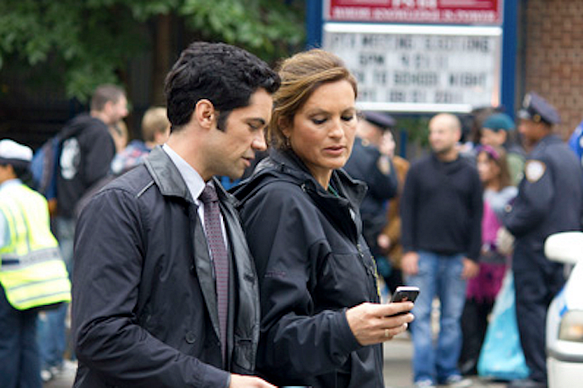
Daniel P. Fleming | Wikicommons Media
She’s got that Olivia Benson persistence with Hercule Poriot’s eye for detail. You can feel her building her case like a seasoned prosecutor; collecting small admissions, spotting subtle inconsistencies. And Morrissey has a tool Poriot never dreamed of, digital forensics. The vehicle’s data recorder could easily contradict any human account. It’s not just evidence. It’s testimony.
The family views her as an irritant and an adversary. But the novel subtly and slowly shows us that her mission is not malicious. She’s seeking justice for the elderly couple killed in the crash, offering solace to their family, and doing the work of figuring out who, if anyone, was responsible for their deaths. I can already she her leading the streaming series.
This isn’t speculative fiction. Recent real-world cases involving autonomous vehicles show the legal gray areas Holsinger explores. He dives into digital vehicle forensics, DACs (Drive Attentiveness Cameras) and SensTrek systems. Holsinger drops us into a reality where juries may soon be watching drivers’ texts in real time as part of trial exhibits.
“The AI retains its own memory of the accident, a memory invulnerable to human error or injury. In effect, the system was spying on us: a ‘sixth witness,’ Morrissey called it. And now our own car might well prove a crucial witness against our son.”
Even if the family avoids criminal charges, as Julia pointed out, the civil suit is waiting in the wings. In tort law, it’s not about guilt beyond a reasonable doubt. It’s about fault, and how much each party carries. Maybe the vehicle’s system was 70% responsible, Charlie 30% and damages would be split accordingly.
So what happens when human behavior, machine error and the legal system collide? Lorelei, the ethicist, is certain:
“That detective can question him all she wants,” she says as she brushes on mascara, “but any decent lawyer could put together a strong argument that the SensTrek was the real offender.”
But blame is rarely clean. Even if the autonomous vehicle is partly to blame, what if Charlie overrode the system? Or the parents were distracted by their own devices ? Or a sibling screamed at the wrong moment? The line between human and machine responsibility gets harder to draw.
What makes Culpability exceptional is that it a thriller that is a family novel. The emotional dynamics are as layered as the legal ones: guilt, loyalty, parental love, exasperating teenagers whose executive functioning abilities haven’t kicked in. Generational misunderstanding. Addiction to our devices and encroaching reliance on AI, even, in one daughter’s case, for companionship.
There’s also a fascinating subplot involving Lorelei’s past and a billionaire tech mogul who suddenly appears — raising questions of betrayal, intellectual property and hidden motives. And Charlie’s budding romance with the mogul’s daughter only tightens the screws.
There are no dramatic trial revelations in Culpability, but the law — and its moral weight — is present on every page. And Detective Morrissey carries that weight. She’s the voice reminding us that justice matters. And she’s got that dry, cop humor too. So, I’ll leave her with the last word:
“Amazing what cars can tell us these days,” the detective muses. “Best part of it all is, these AIs never ask for lawyers.”
Originally published at https://judicialjunkie.substack.com.
See Also:
Lawyers Beyond the Courtroom: In the Booker Prize finalist The Rest of Our Lives. Ben Markovits follows a law professor whose cross-country road trip becomes a meditation on identity, marriage, and the life beyond the law.