Anand Giridharadas shows how the psychiatric records used to defend Daniel Penny also document New York City’s long failure to help the man he killed.
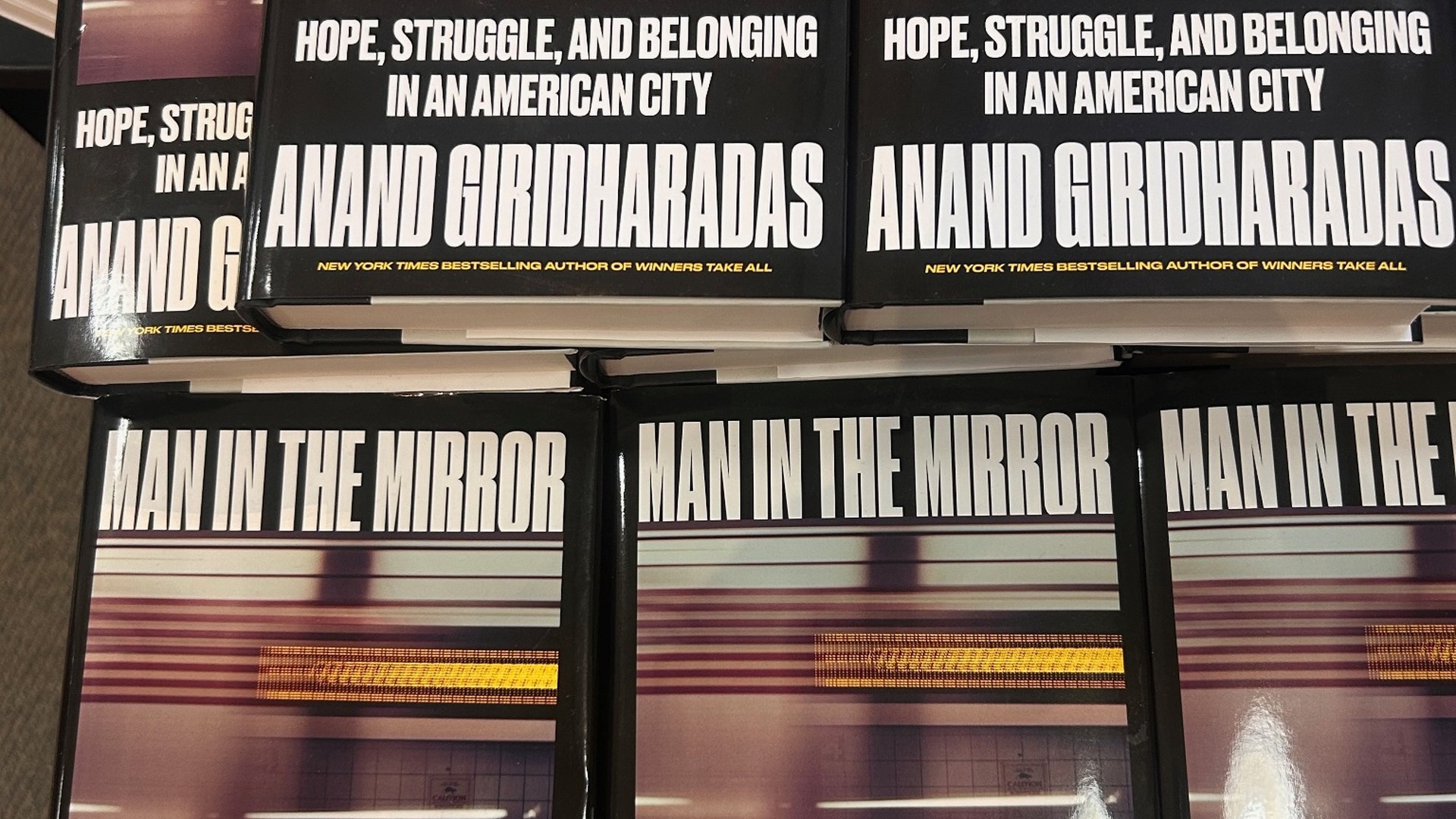
Man in the Mirror: Hope, Struggle, and Belonging in an American City | Anand Giridharadas | Knopf (480 pages)
Jordan Neely left behind a remarkable paper trail: hospital records, psychiatric evaluations, prescriptions, treatment plans, social-worker reports, outreach logs, police encounters. Thousands of pages documented a young man who had been profoundly mentally ill for years. Yet none of that documentation prevented what happened on a New York City subway train.
On May 1, 2023, Neely, who was homeless, was shouting on a northbound F train that he did not care if he died or went to jail. As passengers reacted to his behavior, Daniel Penny, a former Marine, approached Neely from behind and put him in a chokehold. Neely died.
Penny was tried and acquitted. His lawyers argued that he had acted in response to a perceived threat. The defense had put those thousands of pages to a different use.
Anand Giridharadas’s “Man in the Mirror” revisits the killing of Jordan Neely with a scope well beyond the subway car where he died. This is a sad, meticulously reported and indelible book, less a true-crime account of one chokehold than a portrait of every system that put Neely on that train in the first place. The reporting is staggering, occasionally overwhelming in its accumulation of psychiatric intake records, hospitalizations and outreach logs. But Giridharadas distills that documentation into a clear ledger of municipal abandonment.
Giridharadas builds outward into a sprawling cast: the Reverend Al Sharpton, working with Neely’s family while telling people he descends from “the James Brown tradition, not the Martin Luther King Jr. tradition”; PR strategist Michelle Watts, orchestrating press coverage in real time; activist Hawk Newsome, pressuring District Attorney Alvin Bragg to charge Penny; and Manhattan’s chief medical examiner, whose autopsy testimony becomes one of the book’s most devastating set pieces.
Neely’s uncle Christopher tries to restore his nephew to the story. “My nephew was a really fly guy,” he tells reporters, remembering a funny kid who danced like Michael Jackson and was devastated by his mother’s murder when he was fourteen. He also admits that when he found Jordan on a train and tried to bring him home, Jordan ran.
The Dead Man’s Case File
The legal case arrives late, in a chapter titled “The Case Against Jordan Neely.” Giridharadas writes, “Having made the case for Penny, the defense now presented the case against Neely.”
Penny’s lawyers called psychiatrist Dr. Alexander Bardey, who reviewed more than 4,000 pages of Neely’s psychiatric records from 2015 through 2021 and compiled 50 pages of excerpts for the jury. They showed years of psychosis, hallucinations, hospitalizations and a likely diagnosis of schizophrenia; Bardey classified his symptoms as “severe.”
The defense offered the records to support its argument that Neely’s behavior could reasonably have frightened passengers on the train. But Giridharadas sees them as making another case at exactly the same time. If they portrayed Neely as dangerous and “unhinged,” he writes, they also impugned the city and its broken revolving door of mental-health care. The evidence against Neely was also a ledger of opportunities to help him.
One episode, weeks before his death, is almost absurd in its bureaucratic specificity. Neely had agreed to go to a shelter. Police escorted him to a waiting van, but the contracted driver would not let him board without an escort from the Bowery Residents’ Committee. The outreach workers who could have provided one were downstairs in the station and were never brought back in. While everyone argued about protocol, Neely walked away. Three weeks later he was on the F train. Nobody decides to abandon him in that scene. A driver follows a rule, and no one reconnects the pieces.
Giridharadas is also interested in how a criminal case gets made before anyone enters a courtroom. After Neely’s death, Newsome and other activists camped outside Bragg’s office, pushing for Penny to be charged, while Watts put a different picture of Neely into the press: entertainer, son, nephew, human being rather than frightening homeless man. Long before lawyers made their cases to twelve jurors, activists, relatives, publicists and journalists were making competing cases to New York.
Municipal Love
The book’s most extraordinary courtroom sequence comes from the chief medical examiner. Giridharadas walks us through the autopsy with almost uncomfortable precision: the brain, heart, lungs and liver weighed, the airway examined, tissue sliced onto slides. The stomach of a man whose last words had been asking for food contained 50 milliliters of fluid and no recognizable food fragments.
A body neglected and given the runaround by the city in life finally receives extraordinary attention in death. “Municipal love was fickle,” Giridharadas writes. The city was better at measuring what remained in a stomach than at making sure stomachs were full. New York had records of Neely when he was alive. After he died, it had evidence.
The book’s title carries that argument with it. Neely had once earned money performing as Michael Jackson, and Man in the Mirror takes its name from the Jackson song quoted by his family’s lawyers after his death: “I’m looking at the man in the mirror and I’m asking him to change his ways.” The mirror Giridharadas holds up is considerably larger. It reflects a city that knew an extraordinary amount about Jordan Neely and still could not figure out what to do for him.
After the Verdict
In an excellent New York Times Book Review review, Scott Turow, novelist and veteran of both sides of the courtroom, calls Giridharadas a “ferociously talented writer” and praises the book’s remarkable scope. But he makes a sharp legal point: the book repeatedly relays supporters’ descriptions of Neely’s death as “murder” without comment, even though the charge was initially manslaughter and the prosecutor told the jury Penny did not intend to kill.
Turow is right to insist on the distinction. Murder is a legal charge, not simply a synonym for a death someone believes was unjust. But the distinction also helps explain what Giridharadas is doing. He is less interested in retrying Penny than in examining the failures that preceded the encounter on the train, failures that no verdict could resolve.
Near the end of the book, Giridharadas writes about Penny going to a bar after the acquittal, chosen by an official with the New York State Unified Court System because, the official explains, it is a “pro-American bar.” The official points to Navy SEAL insignia on the wall as evidence.
Penny steps outside to smoke and wonders whether he can still have a normal life in New York. Strangers on Thirtieth Street recognize him and stop to shake his hand and thank him.
Moments like these make the book more unsettling than a trial recap or a debate over legal guilt. The jury reached its verdict on Penny’s criminal liability. Giridharadas leaves us with a far heavier question. The paper trail used to explain why Neely appeared so frightening was written line by line, year after year, by a city that watched him slip through every safety net until it was too late.
The Fine Print: Thanks to NetGalley and Knopf for the ARC.