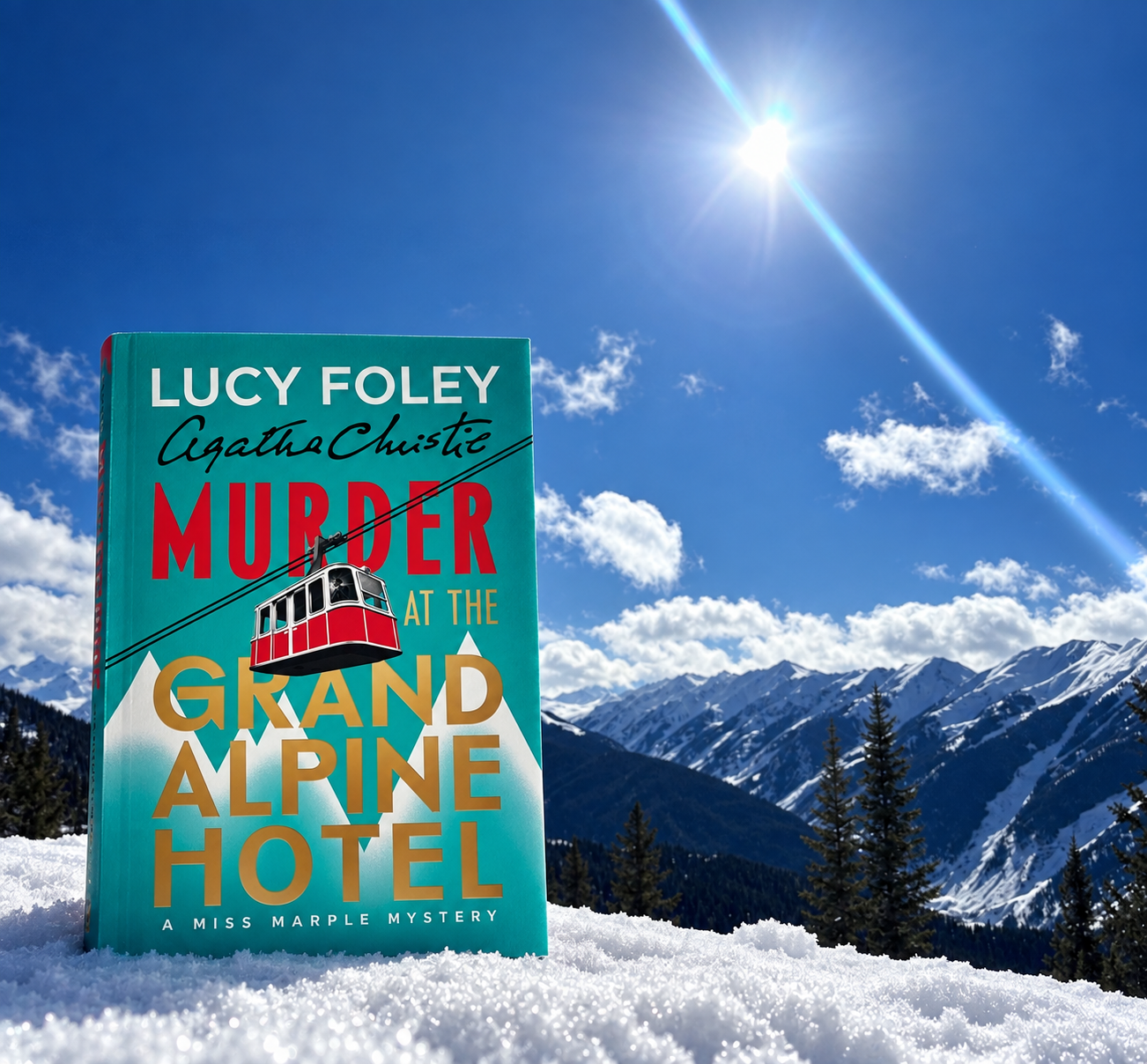
Murder at the Grand Alpine Hotel gives classic Christie more interiority and action. Jane Marple still knows wickedness when she sees it.
Murder at the Grand Alpine Hotel | Lucy Foley and Agatha Christie| William Morrow (304 Pages)
“Jane?”
That’s the first word Diana Glass says to her, on a train, before we know anything else about the woman across the compartment. Something in me settled before the plot had even started: there she is.
I picked up Murder at the Grand Alpine Hotel because I’m a longtime Agatha Christie fan, not because I’m a particular Lucy Foley reader. I’d read The Guest List and liked it well enough, but hadn’t kept up with her subsequent books. I approached an authorized new Miss Marple novel with some trepidation.
The good news is that Foley hasn’t Xeroxed And Then There Were None. She has clearly studied not just Miss Marple, but what makes the best Christie novels work.
The snowbound Swiss hotel carries all the closed-circle menace of a classic mystery, and Foley borrows Christie’s shifting points of view to keep suspicion moving from guest to guest. But this is very much Foley’s reimagining: the Alpine setting is far more lavishly and menacingly rendered than Christie’s typical scenery, and the plotting is razor-sharp.
So I came for Christie rather than Foley, prepared to, well, nit-pick, championing Miss Marple as she was supposed to be. Instead, I found something reassuringly familiar beneath all that modern machinery: Christie’s moral seriousness fully intact.
Everybody Is a Suspect. Everybody Is a Victim.
It is 1950 and Miss Marple has traveled to Switzerland with her friend Dolly Bantry and Dolly’s rather prim companion, Diana Glass. Their destination is the Grand Alpine Hotel, a luxury resort reached by mountain railway and populated by exactly the sort of people one expects to find in a Christie novel: an aging movie star, a politician and his wife, a French detective and, for good measure, six skiing nuns.
Then the snow comes down. The hotel is cut off. Eventually someone dies.
The closed-circle menace inevitably recalls And Then There Were None: a limited cast, no easy escape, the unnerving realization that everyone is not only a potential suspect but a potential victim. Christie famously shifts among the perspectives of her stranded guests, giving us just enough access to their thoughts to make nearly everyone look guilty. Foley uses the same trick, but gives her characters considerably more room inside their own heads.
A ski slope suddenly falls away into a huge drop. The weather closes in. Someone seems to know too much. The mountain offers plenty of ways to die before anyone needs to commit murder.
It’s very Christie. The depth of the interiority feels much more Foley.
Solving It, and Answering For It
Christie herself was no stranger to formal legal mechanics. Witness for the Prosecution puts a courtroom at the center of a mystery and lets truth and verdict come apart in the witness box. Five Little Pigs opens with a legal judgment that has already stood for sixteen years, then asks whether it was ever true. Christie’s detectives were rarely satisfied by an arrest. They wanted to know whether the arrest was correct. They wanted justice.
Jane Marple has always represented a different instrument of justice entirely. She doesn’t, at least overtly, care about rules of evidence, police warrants, or courtroom procedure. Where a detective collects physical clues for a prosecutor, Marple evaluates the human soul.
Foley understands the lethal camouflage that makes Jane Marple so effective. Early on, Diana Glass observes “the very picture of a slightly dithery village spinster,” before noticing those soft china-blue eyes suddenly turn “bright and cool as ice.”
That’s the Marple I remember: underestimated, observant, and quietly ruthless about human nature. When a guest dies, she doesn’t launch into a procedural breakdown of alibis. Asked what she senses, she answers with a single word: “Wickedness.”
The distinction holds even once she has a suspect. Watching someone she has reason to pity, later in the book, her gaze “has lost none of its scrutiny,” even as she makes a sound of sympathy. Feeling for someone and continuing to watch them closely aren’t in tension for her, because sympathy was never her basis for exoneration to begin with.
Foley sets that against the French detective, already conveniently among the trapped guests, who runs the investigation with all the formal authority Marple lacks: interviews, procedure, the standing to compel answers. It’s a useful reminder of a real distinction underneath the amateur-sleuth convention. An untrained bystander’s firsthand account is still competent evidence, whatever her lack of standing to investigate anything at all. Marple can’t arrest anyone, and nothing she notices is admissible because she noticed it. None of that stops her from being right.
Subverting the Dithering Foil
Where Foley’s modern sensibilities shine, without feeling forced, is in how she treats the women surrounding Jane. It would have been easy to turn her great friend Dolly Bantry into a dithering, foolish sidekick who exists solely to ask questions so Marple can look brilliant. Instead, Foley gives us genuine female friendship. Dolly asks smart questions, holds her own, and offers a grounded warmth to Jane’s chillier instincts.
Dolly isn’t above gently checking her, either. When Jane starts drawing one of her trademark comparisons, sizing up a hotel guest as some Alpine echo of someone back in St. Mary Mead, Dolly cuts her off with open exasperation, letting her know she’s heard this particular habit before.
The rest of the female ensemble is equally compelling, particularly Sylvia Sinclair, an aging screen star who understands she is approaching her expiration date and plays her role with calculated, clear-eyed perfection. As suspicion mounts, these women aren’t passive set dressing. They are navigating survival and morality with far more pragmatism than the blustering men around them.
Cold Alps and Post-War Reckonings
Christie herself was hardly indifferent to setting: the Nile, the Caribbean, an English village at Christmas. She knew how to make a place feel worth killing in. But Foley’s Swiss Alps do something more actively menacing with all that beauty. At one point Diana watches a cable car, “the bright red capsule” briefly agleam in gold rays breaking through gathering snow clouds, until the reflected light becomes a “second sun” too bright to look at. Elsewhere the Grand Alpine appears through the storm like a fairy-tale palace, beautiful from a distance and considerably less inviting once you’re inside.
As the snow seals the pass, the Grand Alpine transforms into an isolated prison. The plot takes its time getting to the actual murder, but Foley uses that runway to build tension and drop hints about the world outside. Beneath the resort’s champagne, mink coats, and ice-skating waiters lies the lingering rot of the recent war. As secrets about wartime black markets and stolen gold surface deeper in the book, Foley raises the thematic stakes: what happens when formal human law fails to punish a systemic evil?
Nemesis
When official authority is cut off by the blizzard, Marple becomes something more than a village spinster with sharp eyes. Christie herself wrote a late Marple novel called Nemesis, in which Jane is deputized, by the terms of a dead man’s will, to pursue a justice the law had already failed to deliver. Foley seems to know exactly which Marple she’s borrowing. Cut off from police, courts, and procedure, this Marple doesn’t wait for jurisdiction. She becomes her own.
What Foley took custody of wasn’t just an old woman who notices things. It was this exact refusal to let solving a crime and judging it be the same job.It turns out that true justice doesn’t always happen in a courtroom. Sometimes it’s sitting by the fireplace, knitting quietly, and seeing right through you.
The Fine Print: Thanks to NetGalley and HarperCollins for the ARC.