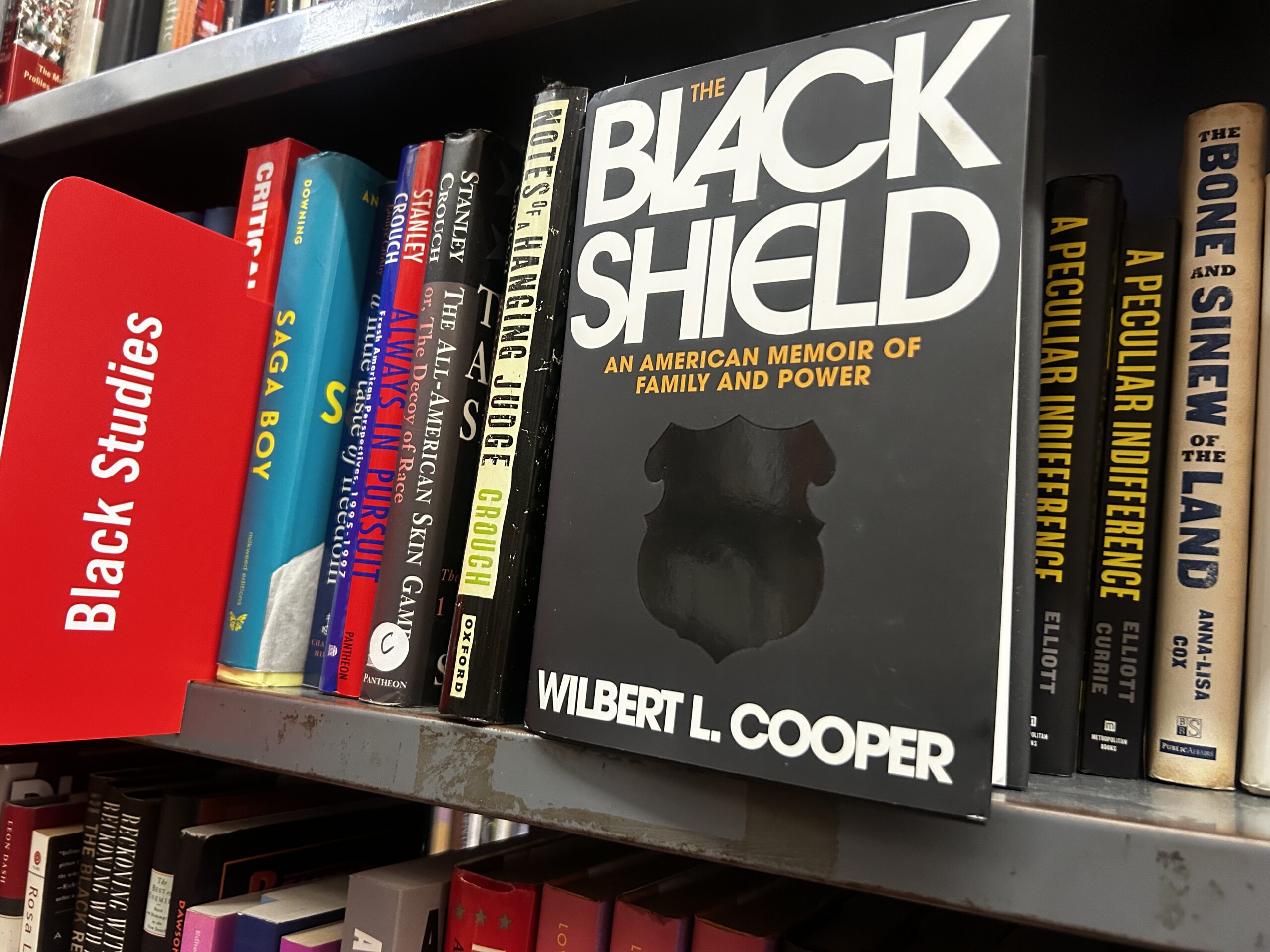
In Wilbert L. Cooper’s new memoir, a consent decree opened the door for his parents’ careers. Cleveland is still arguing, fifty years later, about whether the door needs to stay propped open.
The Black Shield: An American Memoir of Family and Power | Wilbert L. Cooper | Farrar, Straus and Giroux (416 pages)
His father got his gun from the City of Cleveland. So did his mother. Wilbert L. Cooper calls them “tools of policing, the Cooper family business.” His parents held those guns up as symbols of Black freedom in a country that would not stop killing or incarcerating Black people. “When I was a child,” Cooper writes in The Black Shield, “I never questioned that contradiction.”
His book does. The Black Shield is a family memoir, a history of Black policing in Cleveland and, unexpectedly, a genealogy of the consent decree, the legal mechanism that helped put Cooper’s parents in uniform.
As they say in the law, the book is sui generis: part family history, part reported history, part legal excavation. Cooper makes an institution and the law that helped change it feel intensely personal.
The timing is remarkable. Fifty years after a federal court forced Cleveland to open its police force to Black officers like Cooper’s parents, the city is once again arguing about how long that oversight should remain in place.
Not Yet, Says the Judge
In February, the Trump Justice Department, not a fan of federal oversight or DEI, declared Cleveland ready to police itself after a decade under a federal consent decree and joined the city in asking a judge to end it. Chief U.S. District Judge Solomon Oliver, who has overseen the decree since 2015, apparently hadn’t gotten the memo. At a hearing, he reached for Gomer Pyle: “Surprise, surprise, surprise.”
Then, in the checks-and-balances whipsaw we’re living through, Oliver said no. In May, he rejected the request as premature. The consent decree “is not a checklist,” he wrote in a 74-page ruling, but “a framework for systemic change.”
No one else could have written quite this book. Cooper came home to report on the Black Shield, an organization of Black police officers that had aligned itself with Black Lives Matter. Cooper came with a history of his own. His father, Will, and his mother, Gayle, had both been Cleveland cops, as had his sister, an uncle and two great-uncles. Now a staff writer at The Marshall Project covering race and policing, Cooper is reporting on an institution that was also the family business.
The 1970s consent decree that forced Cleveland to hire and promote more Black officers was, Cooper writes, “practically sanctified in my household.” His parents got their jobs because of it. And Cooper’s family has been down this road before, watching an era of court oversight end quietly, only to watch the numbers slide afterward.
The Black Shield takes its title from the Cleveland organization for Black police officers, headquartered in an old bank building that became a refuge from a hostile department and a skeptical community. The book traces two consent decrees through the same police department, fifty years apart.
Welcome to the Force. Sit in Back.
There are plenty of ways into this book. I went straight for the consent decrees, one strand in Cooper’s much larger story of Black policing, family and power.
The first legal battle began in 1972, when the Black Shield’s earlier incarnation, the Shield Club, sued Cleveland over discriminatory hiring and promotions under Fred Johnson’s leadership. Cleveland was 38 percent Black; its police force was 8 percent. The litigation eventually produced a consent decree imposing hiring and promotion requirements.
A court order could get Gayle Cooper onto the force. It couldn’t make her white colleagues believe she belonged there. Two officers assigned to train her put her in the back of the patrol car, where a prisoner would sit, then went off to eat and left her locked inside: “They were supposed to show me some things. But instead, they got out of the car and went to eat. They just left me locked in the back of that car without saying anything.”
When Gayle finally told her son this story, he could feel her own surprise at the disregard she’d endured. Eventually an older white officer took her under his wing. His reasoning was hardly enlightened. Resistance was futile: “If we get rid of her, they will just send another one of them down here.”
The decree could change who got through the door. It couldn’t dictate what happened to them once they were inside.
Orienting Yourself Against a Lie
Cooper’s parents spent their careers answering an accusation nobody ever said to their faces directly: that they didn’t earn their badges, that the rules had been lowered to let them in.
His mother came correct: every detail buttoned down, every procedure over-prepared, nothing left for a white colleague to question. His father played the opposite game, letting people underestimate him until he could use the gap that created. Different tactics, same war. Cooper’s own accounting of that cost is the line worth sitting with:
“I’ve also realized that it’s a tremendous amount of work constantly orienting yourself against a lie.”
So Much for Mission Accomplished
Cleveland’s hiring decree lasted more than two decades. By the time it ended in the mid-1990s, the police force had reached 32.5 percent minority representation, the target the original decree had set. But Cleveland itself had changed; the city was now more than 60 percent non-white.
The decree didn’t end with a dramatic ruling or a final courtroom fight. Amid internal dissension within the Black Shield over whether to keep pushing for it, the case closed with a plain one-page letter to the city’s attorney. Cooper has seen it. After more than twenty years of litigation, the Black Shield had, as he puts it, “laid down their swords.”
Then comes the number that makes all the preceding legal history snap into focus. Cooper reports that two years after the decree expired, the share of Black cadets in Cleveland’s police academy fell from 43 percent to 14.8 percent. Cooper doesn’t argue that the decree failed. The history he reconstructs suggests something colder: the numbers held while someone was watching.
This Time, It’s Misconduct
Fifty years after Fred Johnson went to court, Cleveland is still arguing about consent decrees, but the legal problem has changed.
The 2015 agreement wasn’t about who got hired. It was about how officers used force, how they were held accountable and how they treated people they policed. This spring, the Justice Department and the city said the reforms had worked and federal oversight could end. Judge Oliver agreed that Cleveland had made real, even significant, progress. He still said no.
Remember President Reagan? If you do, you won’t be surprised that the backlash isn’t new. Cooper draws a line from the Reagan administration’s unsuccessful effort to dismantle affirmative-action requirements to the current administration’s “Ending Illegal Discrimination and Restoring Merit-Based Opportunity” executive order. What Reagan wanted but failed to accomplish decades ago, Cooper argues, has returned in a new form.
But The Black Shield has already run another version of this experiment, on the earlier decree, in the same city. Cleveland hit its target, the court stepped back and two years later the number that mattered most had collapsed by roughly two-thirds. Nobody was lying when they declared victory. They just stopped checking before anyone could find out if it would hold.
Cooper’s family is proof that a consent decree can change an institution. It changed who got to wear the badge, changed the economic trajectory of his family and helped remake a police force that had resisted integration for decades. The harder question The Black Shield leaves behind is what makes those changes last once the court stops paying attention.
This time, in Cleveland, the court still thinks it’s a framework for systemic change, not a checklist to clear. Judge Oliver, at least, isn’t ready to call it finished.
The Fine Print: Thanks to NetGalley and Farrar, Straus and Giroux for the ARC.
For a look behind the scenes, check out this short clip of author Wilbert L. Cooper recording the audiobook for The Black Shield, which captures the personal narrative voice driving the memoir.