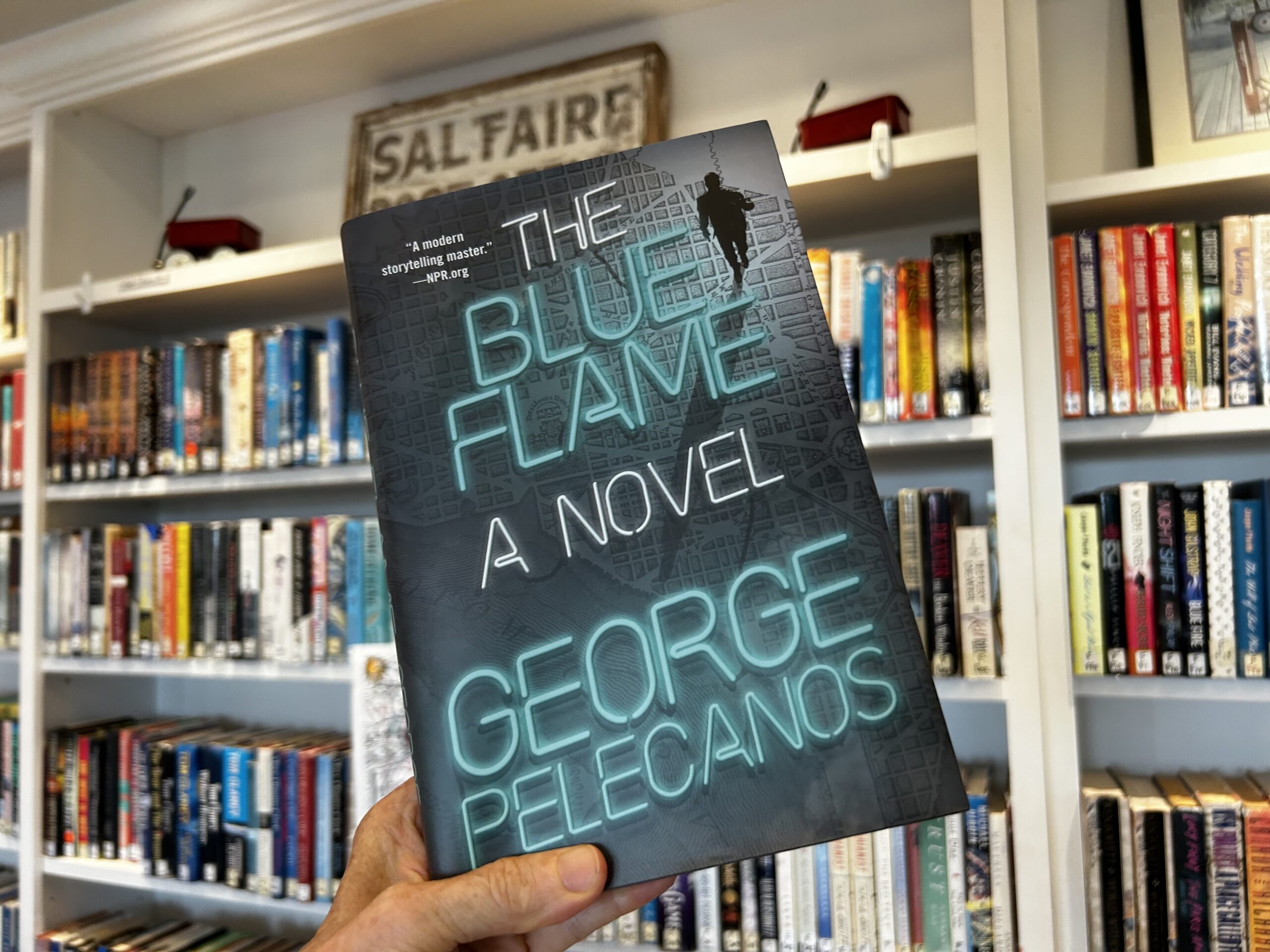
George Pelecanos helped write The Wire’s formidable Maurice Levy. His latest drug lawyer is a different breed. Billy Lake is no Maurice Levy. Not yet, anyway.
The Blue Flame | George Pelecanos | Cardinal (256 pages)
In The Blue Flame, George Pelecanos gives us a drug lawyer with main character syndrome. But Billy Lake isn’t the one running the show.
Lake is a criminal defense lawyer who keeps his clients out of prison. They find him flashy, arrogant and insufferable. They also keep hiring him. Liking your lawyer was never part of the retainer agreement.
We meet Lake through Derek Strange, the Black former cop turned private investigator who actually is running the show. This sixth Strange novel, the first in 14 years, has the bones of a classic PI story: a murder, a questionable client, witnesses who know more than they are saying and a detective who gets paid to sort it out.
The Blue Flame is old-school detective fiction that is stealthily complex, layering fully drawn characters against a Washington where buildings, neighborhoods and even the music carry their own histories. Strange is older now and decidedly unsentimental about what solving a crime can fix. Yet the title points to what still burns in him, an instinct left over from his years as a D.C. cop: once you’ve worn the uniform, the blue flame never truly goes out.
Everybody Hates Billy
Lake arrives at Strange’s office in an Italian suit, French cuffs, a Hermès tie, red-soled shoes, an expensive watch and a Mercedes S-Class. Strange takes in the entire production and reaches a concise verdict: “Billy Lake looked exactly like the person he was: a drug lawyer.”
The lawyer hires Strange to shore up the defense of Antone Anthony, a marijuana dealer charged with murdering his childhood friend Nigel Walker. A gun found in Anthony’s stash house matches the murder weapon, but Anthony insists he had nothing to do with the killing. Lake hires Strange believing the aging detective will do just enough and won’t have the energy to turn over too many rocks. Strange, of course, keeps turning them over.
Pelecanos doesn’t need a high concept to manufacture suspense. Strange gets hired. He reads discovery. He visits Anthony in jail. He interviews an alibi witness. He talks to a grieving mother. He buys a potential witness a drink, then another, and gets more information out of her than he feels entirely comfortable having obtained. Detectives follow their own leads. People lie, omit things and occasionally tell the truth.
The PI learns no one is buying Lake’s act. Strange dislikes Lake’s habit of calling him “big man” and the patronizing tone that goes with it. Grace, Strange’s investigator, has seen Lake grandstanding on local television and dismisses him as “a cut-rate Johnnie Cochran.” A potential witness’s father reacts to Lake’s name “as if a waiter had served him a plate of feces.” Eventually even Strange’s dog growls at him.
The clothes caught my attention. Years ago, when I was at Court TV, Murray Richman, the very successful New York criminal defense lawyer known as “Don’t Worry Murray,” told me that juries didn’t want a defense attorney who looked like a working man. They wanted flash: the expensive suit, the watch, the unmistakable suggestion that this was a lawyer who won. I was never sure whether he was right. He did win.
By Murray’s measure, Lake certainly looks the part. But the people Pelecanos puts around him aren’t buying the performance. They know the game.
Anthony certainly does. He knows that Lake grew up in Sixteenth Street Heights, the son of a federal judge, attended private school and Georgetown Law and now likes to perform a street credibility he never earned.
Strange asks the obvious question: Why let the guy represent you?
“He specializes in clients like me. He’s gotten a lot of dealers off or gotten them minimal time. I don’t have to like him. I tolerate him if it’s good for me.”
There it is. The Good Bad Lawyer’s entire business model.
Lake has plenty of company. John Grisham practically specializes in the species: Avery Tolar in The Firm, Roy Foltrigg in The Client. Simon Latch, milking an elderly client in The Widow, is something else entirely: a plain old Bad Bad Lawyer.
The best of the breed have charm. Mickey Haller has it. Saul Goodman has it in abundance. Lake conspicuously does not. I hope Pelecanos brings him back. I’d like to see what Billy Lake does with a jury.
How Bad Is Bad?
What Pelecanos does show us is how far Lake might be willing to go. When Lake worries that a witness could hurt the defense, he floats a solution to Anthony. He knows someone who “puts work in.” Anthony understands exactly what he means and immediately refuses. The witness is his friend.
It is quite a moment when the accused drug dealer has to explain professional boundaries to his lawyer.
Later, Anthony tells Strange about the exchange, concluding that Lake is just “a punk who likes to play like he’s hard” who “probably heard those words on one of those ‘hood shows he watches on Starz or sumshit.”
The television crack carries a nice irony. Pelecanos wrote some of the pivotal teleplays on The Wire, including episodes in which Maurice Levy manages legal damage control for the Barksdale organization and steers Avon Barksdale through his parole hearing. He knows what a lawyer embedded in the drug trade looks like. But Maurice Levy never seemed to be auditioning for the role. Anthony seems to think Billy Lake is.
Things Change
The headline, though, is Derek Strange. The private investigator is now in what Pelecanos calls his “sunset years.” Strange has aged across the books, from the 12-year-old we meet in Hard Revolution to the investigator still working cases in The Blue Flame.
One other thing Pelecanos told Crime Fiction Lover gets at what may be my favorite part of the novel: “As always, the book deals with the passage of time.”
It isn’t only Strange that is changing. It’s D.C. One of the pleasures of detective fiction is armchair travel, and Pelecanos’s Washington is extraordinarily precise. But the geography in The Blue Flame does something more interesting than establish where everybody is. It becomes evidence of time passing.
The detective passes the CVS on Newton Street and remembers what the building used to be: the Newton Theater, which briefly became a punk venue in 1984, hosting bands including Void and Government Issue. The old curved marquee is still there. Buildings in Pelecanos’s Washington have biographies.
So do his characters. That is what makes the novel’s movement among Strange, homicide detectives, witnesses, suspects, parents and lawyers feel so effortless. The mystery matters, but so does the pizza place in Brookland, the neighborhood somebody grew up in, the job somebody goes to every morning and the old theater that became a drugstore. And, of course, the lawyer in the French cuffs.
Billy Lake is hardly the moral center of The Blue Flame. That job belongs to Strange, who keeps discovering that the people involved in his investigation matter to him independently of the case he was paid to investigate. That tells you almost everything about the distance between the two men. Lake wants to know what can help his client. Strange keeps wondering what justice is.