
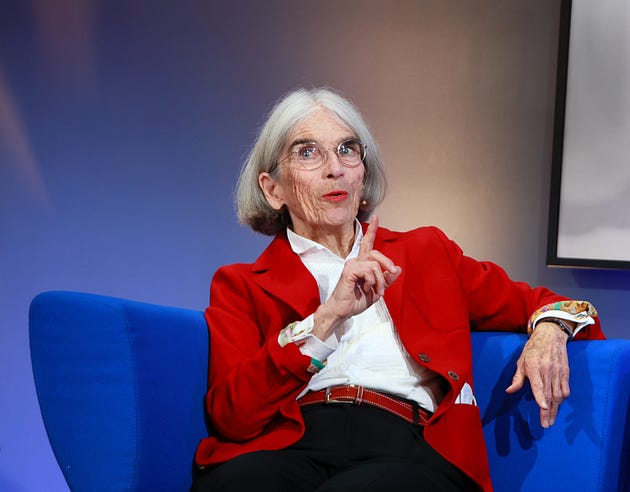
This isn’t a structured memoir; it’s a free-flowing, brilliant conversation that jumps from Hemingway to opera to the psychology of murderers. The food is excellent, the wine is flowing and Donna Leon is holding court.
Backstage: Stories of a Writing Life | Donna Leon | Atlantic Monthly Press (170 pages)
What if you could sit at a table with Donna Leon and spend the evening listening to her talk about whatever comes to mind? That’s the feeling of reading Backstage: Stories of a Writing Life. This isn’t a structured memoir; it’s a free-flowing, brilliant conversation that jumps from Hemingway to opera to the psychology of murderers.
Think of it as a meandering dinner party with your brilliant, funny and observant friend. The food is excellent, the wine is flowing and Donna Leon is holding court. She moves fluidly from Frank Zappa to Venice’s most spectacular carnival opera season (1729) to Raymond Chandler’s The Big Sleep to dissecting the narrative of the children’s story “Jack and Jill.” You don’t always know where the discussion is going, but you’re very glad to be at the table.
Backstage is a bit of a stream-of-consciousness exercise. And I don’t mean that in a bad way.
As a legal book blogger, I approached this work expecting the usual dose of Venetian crime and thoughtful musings from the mind behind Guido Brunetti. I love the series, in part because it transports me to Venice, a truly sui generis city with its web of canals and complex history. The standout? The jewel-box opera house, La Fenice, which is aptly named “The Phoenix” for having risen from the ashes not once, but twice, after being destroyed by fire. My favorite time to visit is in winter, which is why I wrote this travel story for the New York Times: “ Breathing Easy Without the Throngs.”
In the relative quiet of post-lockdown Venice, I went back and lit a candle at the Basilica di Santa Maria della Salute, which was built in gratitude for the city’s deliverance from a 17th-century plague. The symbolism was not lost on me.
But I, like Leon, digress. Back to the book. This isn’t a police procedural or a memoir (she’s already written that, with Wandering through Life). The essays in Backstage are loose and impressionistic. And, yes, sometimes she’s repetitive, but the pages are filled with gold.
My motto quickly became: “Let Leon be Leon.”

So That’s Why That Book Worked
Reading Backstage gave me the same feeling I got from George Saunders’s A Swim in a Pond in the Rain. While Saunders’s work is based on formal lectures about Russian short stories, Leon’s insights are far more off-the-cuff. But both writers explain the mechanics of what makes fiction work and the technical discipline of writing. Both also view fiction as a guide, or Baedeker, to life — and vice versa.
Okay. This I just love. She does a deep dive into her summer re-reading of Tolstoy’s The Death of Ivan Ilych. Leoncites the prolific writer and pioneering media provocateur Gore Vidal — “at least, ‘I think it was’ “ — dismissing the novella as being “tediously didactic.” Someone else out there still thinks of Gore Vidal!
Then she critiques the work. She briefly lands on Aristotle and begins to explore how much the novella reflects our times, but quickly cuts herself off, wary of committing the same rhetorical crime of being “tediously didactic.” (“But, lest another Gore Vidal come upon these words, I shall not belabour that point.”) There are worse writers to have living rent-free in your mind.
The topics range widely from childhood in New Jersey to teaching in Iran, with lots of classical music along the way. All smart and charming, but to me Backstage is most rewarding when Leon talks about writing.
Whydunits and Other Delicious Subversions
Leon doesn’t just praise a novel (or work of art) and move on. She pinpoints with specificity why she admires it. She calls Ruth Rendell’s A Judgment in Stone one of the greatest crime novels ever written. And she brings the receipts.
Instead of a typical whodunit, this novel reveals the killer, the crime, and the motive in the very first sentence, turning genre conventions on their head. As Leon points out, this brilliance forces the reader to go deeper, to understand the psychological layers beneath it all. That simple declarative sentence, she writes, doesn’t fully explain why. “The book does, and with such brilliance that it remains, for me, one of the best crime novels.”
Dissecting the opening of Barbara Vine’s A Dark-Adapted Eye (Rendell’s alter ego), Leon showing just how deeply she thinks about her fellow writer’s storytelling. The story begins with the main character’s execution. “The manipulation of the chronology here is masterful…”
I downloaded both novels as soon as I finished her essays.
She applies a similar level of analysis to the novels of Ross Macdonald, arguing there are “few better, more concrete examples of a writer who went quietly and artfully about the business of showing his readers the souls of his characters. Even more artfully, Macdonald kept authorial comment to a minimum…”
In discussing Macdonald, Leon precisely and convincingly weaves in Proust, Homer, and Dickens and, for good measure, Goya. “As in Dickens, Macdonald’s chickens always come home to roost,” and she praises his “prose so elegant and rich as to drive any writer to fits of envy.”
Mystery writing, of course, is often unfairly pigeonholed. Leon is not burdened by genre guardrails in writing, reading or critiquing. She dives into the notoriously detached Ernest Hemingway, pointing out how he tries to nudge readers toward his preferred views, despite his famously lean style. There’s “no question who’s the bad guy” in “Hills Like White Elephants,” she writes, “no matter how hard the voice transmitting that opinion strives towards inaudibility.”
Literary Bromances and Sociopaths You Want to Drink With
Leon’s admiration for writers is infectious and convincing. She gives nuanced rationales for her passions. She doesn’t just analyze; she champions. This is especially clear in her full-throated love for Patrick O’Brian and the Master and Commander series. “I do not like Patrick O’Brian: I adore him,” she writes.
What makes the 20-book series work? She cites literary ancestors buddy teams like Achilles and Patroclus all the way to Butch Cassidy and the Sundance Kid. Leon distills it to its essence, focusing on the deep friendship between Captain Jack Aubrey and Dr. Stephen Maturin. As she puts it, “guys are pals and they have adventures.”
(They also have a foil: “Just as the Greeks and the Trojans, and Butch and the Kid had the Bolivians, O’Brian’s heroes have Napoleon and the French.”)
It isn’t quite a friendship, but one section nails why Tom Ripley of Patricia Highsmith’s novels works so well, arguing that the reader finds sympathy with a sociopath. “He is the kind of man you’d like to have a drink with, and while you were at it, he’d have your wallet — and then perhaps your life.”
As a rule, she has no patience for serial killers in fiction, though. I could not agree with her more! But Leon goes beyond my pedestrian squeamish response to explain the real problem with such plots:
“[T]he tedious serial killers who can do nothing but chop, chop, chop, are dull to the point of tears because they are so unbelievable, their evil is so ungraspable and alien.”
That leads us on a delightful journey to American slang (the word nutcase) and on to the main character in the Halle Handel Festival’s 2022 production of Orlando. Somehow, it makes sense.
The Party’s Over, but I’m Still Thinking About It
IsBackstage a tidy, cohesive read? No, and it doesn’t try to be. Leon may circle back on the same ideas and then drop a line so brilliant you have to stop and highlight it. But for fans of her work — or fans of writing about writing — it’s a rich, surprising book. Like a dinner party where the guests stay long past dessert, because the conversation is just that good.
I came for Donna Leon the mystery writer. I stayed for Donna Leon the reader, the thinker, the literary enthusiast. I left with a whole new TBR.
My Literary Hangover: The TBR Edition
- The Big Sleep by Raymond Chandler
- “Hills Like White Elephants” by Ernest Hemingway
- The Talented Mr. Ripley by Patricia Highsmith (reread)
- Master and Commander by Patrick O’Brian
- Pride and Prejudice by Jane Austen (reread)
- Anything by Ross Macdonald (start with The Chill or The Zebra-Striped Hearse)
- A Judgment in Stone by Ruth Rendell
- A Dark-Adapted Eye by Barbara Vine (Ruth Rendell)
- The Death of Ivan Ilych by Leo Tolstoy
Fine Print: Thanks to NetGalley and Grove Atlantic for the ARC
Originally published on Books Are Our Superpower.