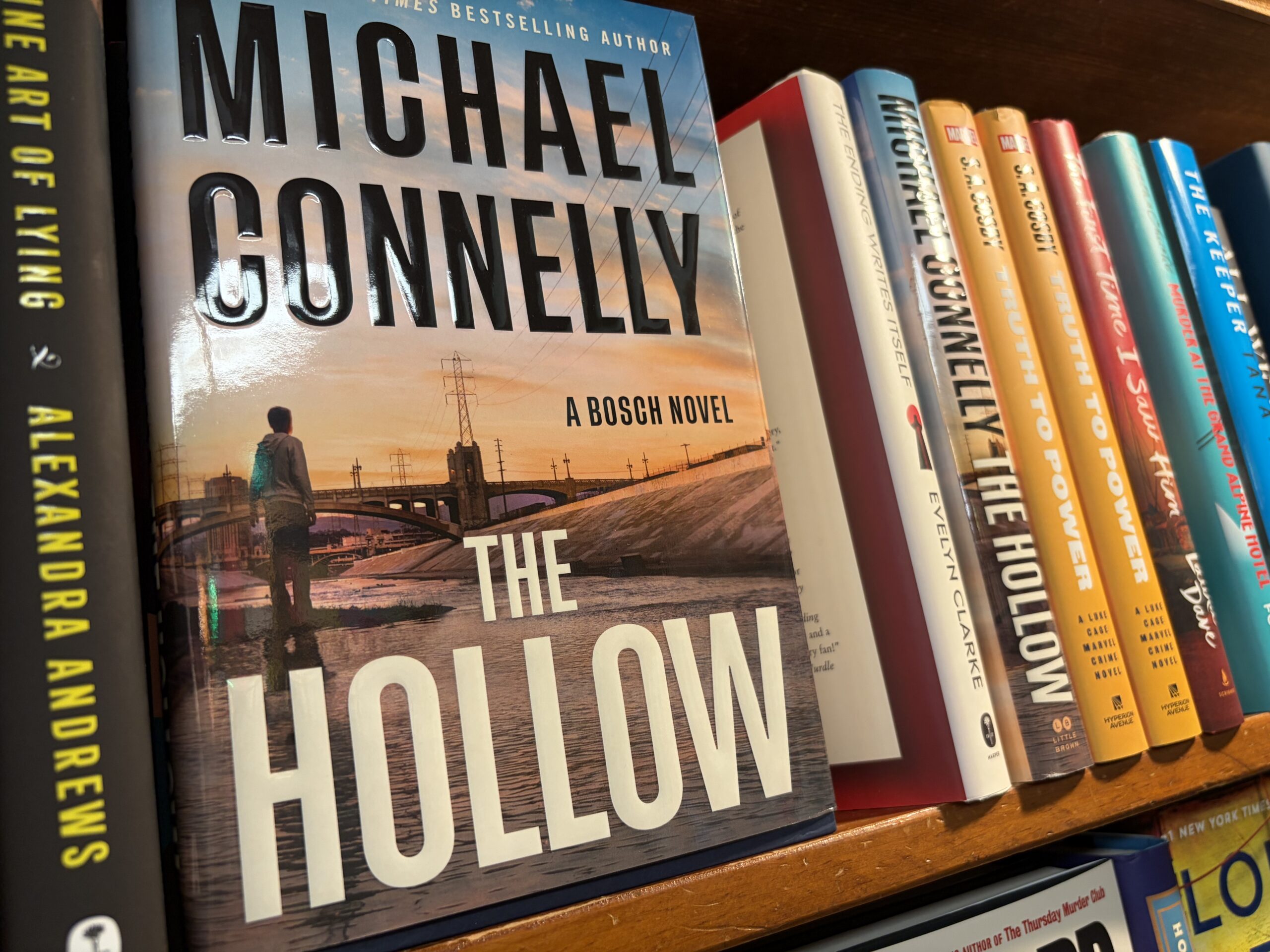
The Hollow: A $4 billion abuse settlement, sealed discovery and a spectacular suppression hearing
Michael Connelly hasn’t worked a newspaper beat in decades. You wouldn’t know it from his novels.
The Proving Ground took on artificial intelligence and its legal liabilities. Ironwood took on immigration enforcement and constitutional shortcuts. Now The Hollow takes on the $4 billion settlement Los Angeles County announced in April 2025 over decades of child sexual abuse at county-run institutions, including MacLaren Children’s Center
Here’s the remarkable part. Connelly didn’t have to invent a childhood connection to MacLaren for Harry Bosch. He’d established it decades ago, in earlier novels including The Black Ice and The Last Coyote. Now a real-world settlement has given him a way to revisit that history. I can only imagine the gears turning when he saw the news.
Harry Bosch needs a cane now. His instincts and stubbornness remain intact, but he’s no longer physically the detective Connelly introduced more than thirty years ago. And when there’s more life behind you than ahead, it’s hardly unusual for the mind to wander backward, particularly to childhood. For Bosch, of course, the past arrives as a case.
And there’s plenty of law in this one. In The Hollow, a multibillion-dollar settlement raises questions about compensation, attorneys’ fees and confidential discovery. A cold-case investigation produces evidence that may not survive a Fourth Amendment challenge. A suppression hearing becomes one of the book’s best scenes. There’s even a question about whether a cemetery plot constitutes an easement. Property law in a Harry Bosch novel!
Connelly makes legal technicalities interesting because they determine what his characters can do, what evidence they can use and sometimes whether a murder can be prosecuted at all.
The Trouble With Getting Paid
A $4 billion settlement is supposed to resolve the past. For Bosch, it reopens it.
Bosch spent part of his childhood at MacLaren in the 1960s, where he remembers a punishment room known as the Hollow and a boy named Charlie “Chops” Lamb, who was beaten to death. The death was barely investigated. Bosch has always lived by the code “Everybody counts or nobody counts.” Charlie was one of the children nobody counted, and Bosch hasn’t forgotten him.
Bosch’s half-brother, Mickey Haller, represents him in the MacLaren litigation. The settlement entitles Bosch to $400,000 for the physical abuse he suffered there. Haller explains how the awards are calculated, with a special master assigning survivors to compensation tiers according to the severity of their injuries. The lawyers’ fees are capped, a detail Bosch is quick to question.
But Bosch has a different objective. He joined the lawsuit because he wants the discovery, the documents and evidence produced during the litigation. Somewhere in those records, he hopes, is a clue to Charlie’s death.
Haller has a problem with that request. The discovery was sealed as part of the settlement, and under its terms he must delete his files. Bosch threatens not to approve the settlement unless he gets access, but Haller explains that refusing the money won’t change the court’s order.
“Either way, the judge seals the discovery.”
It’s a wonderful Connelly complication. Bosch has joined a civil lawsuit to obtain evidence for a homicide investigation, only to discover that the settlement may put that evidence beyond his reach. And the lawyer telling him so is his own half-brother.
Haller, incidentally, has become a public-interest lawyer and traded his Lincoln for an autonomous electric car. Bosch wants to know what happened to the Lincoln. It’s a small, funny moment, and a reminder that Connelly doesn’t insist on preserving his characters exactly as we first met them.
The Cemetery Caper
The novel actually opens with another murder, one Bosch investigated twenty-five years earlier. Jennifer Talbot was found beaten to death, and Bosch became convinced her estranged husband, Gregory, was responsible. He spent two hours questioning Talbot, slowly working through inconsistencies in his story, until the suspect ended the interrogation by “playing the lawyer card,” as Connelly puts it. Bosch believed he’d solved the case. He just couldn’t make the arrest.
Now Renée Ballard’s cold-case unit is pursuing Talbot again, and this time investigators have come up with an ingenious way to listen in. It involves a recording device concealed in a tulip arrangement at Jennifer Talbot’s grave. The device eventually travels somewhere the investigators hadn’t intended: Talbot’s car.
Bosch immediately sees the legal problem.
“I don’t want to rain on anybody’s parade, but you didn’t get a warrant to bug the guy’s car, right?” he asks. “So is what we got even going to be admissible?”
That’s the kind of exchange that makes me happy to be reading a Connelly novel. The detectives have potentially incriminating evidence, but they may also have a Fourth Amendment problem. Ballard turns to a former prosecutor working with her cold-case unit for an opinion, and the district attorney eventually agrees to proceed, anticipating that the recording’s admissibility may be challenged on appeal.
Sure enough, the defense moves to suppress the evidence from what the investigators call the “cemetery caper.” Connelly even makes the litigation strategy interesting. The lawyers hope that challenging the recording will delay proceedings, potentially for years, while they argue that their clients should remain free pending a final ruling. The motion is about admissibility, but it also becomes a means of buying time.
The resulting suppression hearing is one of the pleasures of the book, not only because of the legal arguments but because Connelly notices the small rituals of courthouse life. Bosch gets held up in the morning rush because his retired badge no longer lets him bypass the security and elevator lines. A defense lawyer rises to address the judge and buttons his jacket, an affectation Bosch imagines might be intended to evoke a knight preparing for battle. Anyone who has spent time watching lawyers in court will recognize the gesture.
The defense argues that the recording was obtained in violation of the Fourth Amendment. The prosecution counters that the investigators placed the device in a cemetery open to the public, where they had no need for a warrant, and that Talbot himself carried it into his car. Why should the government lose evidence because the suspect moved the recording device?
Then comes an unexpected detour into property law. The defense raises the question of who owns Jennifer Talbot’s grave. The prosecution responds that purchasing a cemetery plot conveys an easement, while the cemetery retains ownership of the land. Suddenly, the legal status of a burial plot matters to a murder prosecution.
This is what Connelly does so well. He doesn’t simply have his detectives uncover evidence and march into court. He knows that evidence must survive legal scrutiny, and he understands how lawyers can use procedural challenges to alter the course of a prosecution. The law isn’t an interruption of the story. It’s what makes the story interesting.
Meanwhile, Bosch’s investigation of Charlie Lamb eventually intersects with a much larger inquiry, bringing together crimes, jurisdictions and decades that initially seem to have little to do with one another. I won’t explain how the pieces connect, but it’s an audacious bit of plotting. Connelly makes the whole thing work without losing sight of the boy whose death set Bosch looking backward.
An Old Debt
What makes this particular novel affecting is that Bosch is running out of time. He can still pursue the truth, but he can’t pretend he has unlimited years ahead of him. Charlie Lamb died more than sixty years ago, and Bosch may be one of the last people alive who remembers him. That gives an otherwise elaborate legal mystery an unexpectedly personal urgency.
Television is turning back the clock with Bosch: Start of Watch, a prequel about the detective’s early career. Connelly is moving the other way. I’ve grown old with Harry Bosch, and I’m glad his creator has let him grow old, too. He needs a cane now, but he hasn’t forgotten what he owes the dead.
The Fine Print: Thanks to Little, Brown and NetGalley for the ARC.