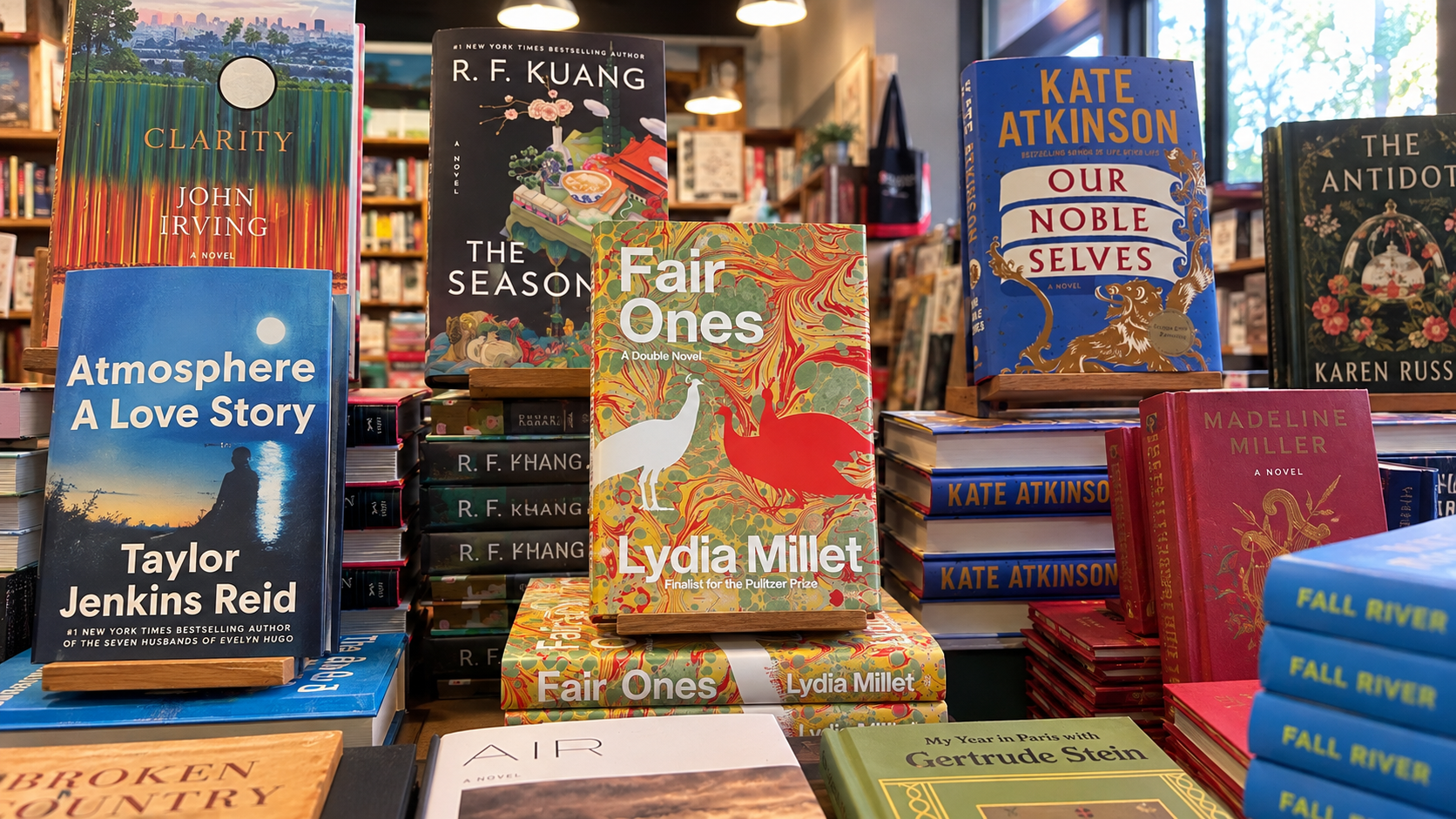
A friend’s death looks like an accident until two friends begin asking the questions the police didn’t. But solving what happened is only part of Lydia Millet’s story.
Fair Ones: A Double Novel | Lydia Millet | W. W. Norton & Company (384 pages)
I picked up Lydia Millet’s Fair Ones because I wanted to see what she would do with grief.
A Children’s Bible, a National Book Award finalist, is one of my favorites of hers. Her story collection Love in Infant Monkeys was a Pulitzer finalist, and Atavists just won the 2026 Mark Twain American Voice in Literature Award, with judges praising its “precise, perfect, deadpan prose.” She is exactly the kind of novelist I wanted writing about the aftermath of a violent death: not just the loss itself, but what happens to the people left behind.
The novel delivers on that front. Fair Ones navigates the aftershocks of grief and trauma with remarkable compassion and sharp wit. From the victim’s friends, brother, family a loose circle of boyfriends, book-club friends and colleagues, everyone is so specific that nobody feels like a type. No character gets shortchanged in this warm, deeply observant portrait of friendship and family ties.
What I did not expect was how much law this novel would hold, or that it would also contain a very satisfying. mystery.
Talking Around It: How Grief Sounds in Fair Ones
Claire’s death initially looks like a terrible accident. A thirteen-year-old boy, a gun, a Brooklyn bus stop. The police have an explanation and, as far as they are concerned, the case is essentially closed.
Fair Ones is divided into two halves. Fair is narrated by Mara in the immediate aftermath of Claire’s death. Ones, told by Jen a year later, shifts the perspective and quietly changes what we understand about both the past and the women who survived it.
For quite a while, that is the novel I thought I was reading. Millet is interested in what grief actually looks like once the memorials and the initial shock are over. And her characters talk. A lot. Early on, Jen imposes a “moratorium” on discussing “the event,” a rule the characters enforce by talking about everything else.
Richard, Jen’s boyfriend, rails against nail clippers that spray clippings across the bathroom floor (“Clippers have a serious design flaw,” said Richard. “The clippings shoot out all over the place. Sharp and practically invisible. Every time I clip, I’m like what the fuck.”). Then there’s the wry movie commentary on the unnamed Hobbit: “Elves are pretty cringe.” “Even Orlando Bloom?” I asked. “He kind of pulls it off,” said Mara. “But still, the hair.”
Depending on your tolerance for philosophical ping-pong, these rhythmic exchanges might divide readers, and I sometimes found them exhausting. Then I began to think that was part of the point. People still have to go to work and eat dinner after somebody dies. They worry about their parents, get high, fall in love, complain about the bathroom and make jokes.
Millet lets grief sit next to all of it rather than turning it into a solemn literary object. The conversations can feel like Seinfeld after somebody has wandered into Sartre’s No Exit: funny, hyper-specific, occasionally maddening and conducted by people talking partly to avoid saying the thing that actually hurts.
Something Doesn’t Fit: When Grief Becomes Investigation
Mara keeps returning to what she didn’t see. She imagines Claire’s last moments: the Converse sneakers, the sound of the gun, the hard sidewalk, whether a paramedic held her hand or gave her something for the pain. She wasn’t there. She is reconstructing the death of her friend because the missing pieces are unbearable. Jen starts reconstructing it another way.
The official story doesn’t satisfy Claire’s friends. They don’t become detectives because they are amateur sleuths. This isn’t that kind of book. But small inconsistencies begin to bother them, particularly the question of why a thirteen-year-old boy was carrying a loaded gun outside Claire’s school, ten minutes from his own.
That makes Fair Ones a mystery, almost.
What I like is the way Millet lets the mystery emerge from the grief rather than announcing itself as a plot. Jen begins to wonder whether the police looked hard enough. Mara has a connection to a medical examiner through her tutoring work. Eventually a detective takes another look at the file and finds holes in the original investigation.
That is about as far as I want to go. There are spoilers and then there are spoilers, and much of the pleasure of Fair Ones is watching the explanation emerge from details that don’t initially look like clues.
But I can say this: there is a lot of law in this novel. Guns and safe-storage laws. Criminal responsibility for what someone else does. Charging decisions. Plea bargaining. Restorative justice. Prison reform. Even a Section 504 plan turns up.
§ 504: The Child the System Missed
The last one delighted me. At one point a detective recognizes that a child may need a 504 plan at school. Millet doesn’t stop the novel to explain what that is, and she doesn’t make the detail sound like research she’s eager to show off. It simply comes up.
Section 504 of the Rehabilitation Act of 1973 requires public schools to provide accommodations to eligible students with disabilities so they can participate on an equal basis with their peers. In New York City, that falls to the Department of Education.
It’s a tiny detail, but a revealing one. Millet knows what these systems are called and how people who deal with them actually talk. Someone just needs a 504.
The same thing happens with the gun. At one point the characters ask why an adult who left a firearm accessible to a child isn’t being prosecuted. A character answers that safe-storage laws aren’t really enforceable. New York does have them. Penal Law § 265.45 requires secure storage when a gun owner lives with someone under 18; a violation is a class A misdemeanor. A lesser, fine-only violation applies when a child under 16 is likely to gain access.
Fair Ones isn’t a treatise on New York gun law, and I won’t turn this into one. What impressed me was that the law is there because it belongs there.
One more piece of New York law hovers over the novel, but explaining why would give away too much. So I’ll leave you with Penal Law § 20.00. Hit the link after you finish the book.
Who Gets Justice?: Restorative Justice After a Violent Death
Claire believed in restorative justice and prison reform. That matters once the people who loved her have to think about what justice for her death might actually mean. Her mother, June, doesn’t call for vengeance either. At Claire’s memorial service she tells mourners that “forgiveness is good, but it’s not the end of the path.” She later becomes an advocate for gun control and trauma support.
That complicates the tidy ending a conventional crime novel might give us. Discover what happened. Identify who is responsible. Make an arrest. Impose a punishment. Justice.
Except Fair Ones has spent too much time inside grief to pretend it works that neatly.
That is what makes the mystery in Fair Ones different from the one in a conventional thriller. In a thriller, solving the puzzle is usually the point. Here, solving it answers only one question: what happened to Claire. It doesn’t tell Mara and Jen how to live without her.
Mara can reconstruct Claire’s final moments. Jen can find connections the police missed. The legal system can sort through responsibility and punishment. None of it answers the question grief keeps asking: what would Claire be doing now?
By the time Jen tells her half of the story a year later, life has gone on. There are relationships and jobs and parents and all those absurd little things people talk about when they’re trying to keep living. They bothered me sometimes when I was reading them. By the end, I understood why they were there.
The mystery has an answer. The loss doesn’t. Claire is gone, but the conversations keep going. So do the people who loved her.
The Fine Print: Thanks to NetGalley and W. W. Norton & Company for the ARC.