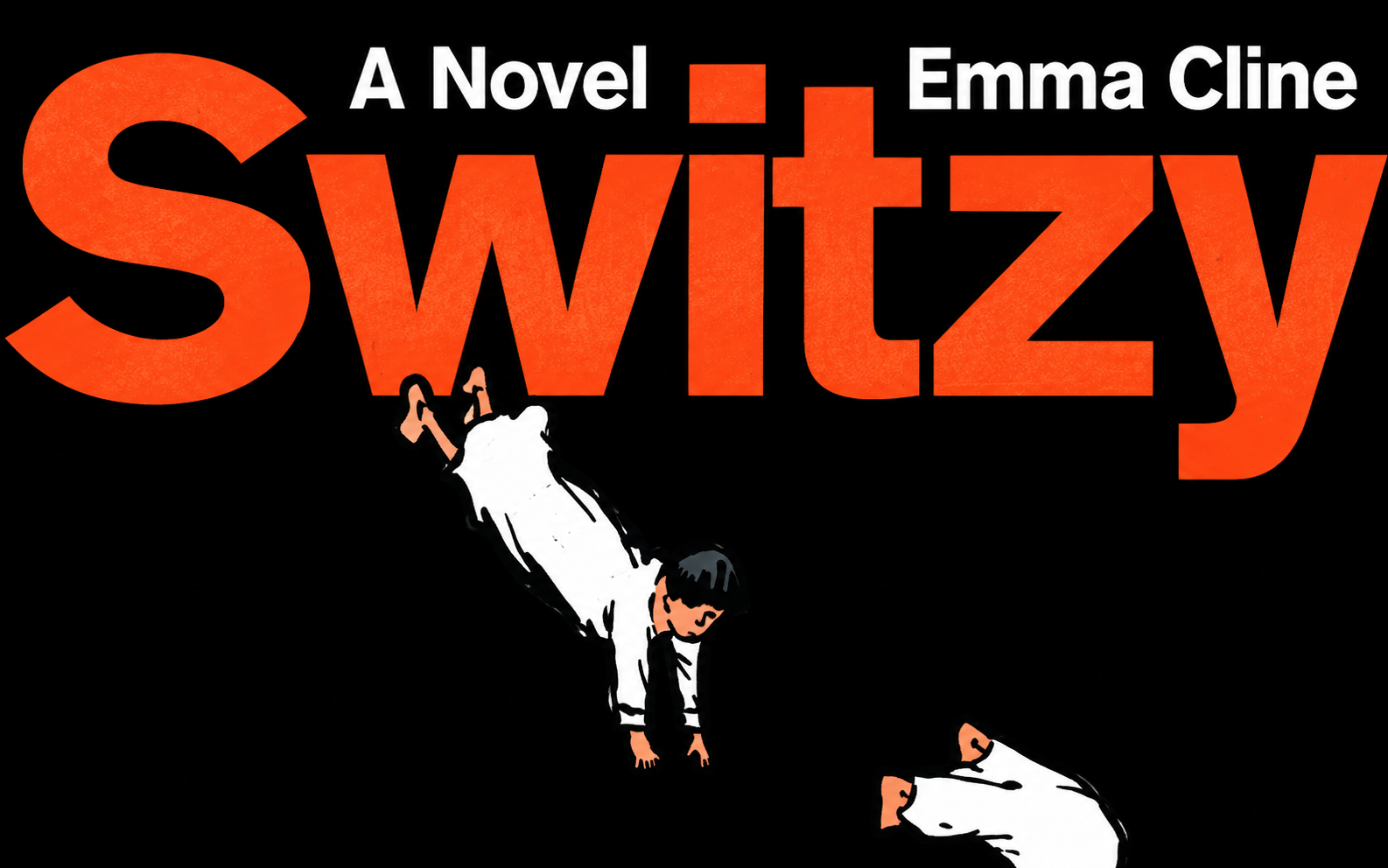
An existential mystery finds the fine print in choosing when to die.
Switzy | Emma Cline | Random House (352 pages)
David Hastings is a retired executive in his 70s on a private-jet farewell tour toward an assisted-death clinic in Zurich, his mind rapidly deteriorating. The paperwork, unfortunately, requires that he still have one.
Emma Cline‘s Switzy is not an easy read. The material is heavy and the fractured narration requires concentration. But it is a genuinely beautiful novel, and one best read in as few sittings as possible. There is an almost dreamlike quality to being inside David’s mind; put the book down for too long and the reader risks breaking the spell.
Cline’s third novel, Switzy, is on this year’s Booker Prize longlist and is her boldest formal swerve yet. The Girls put us inside a lonely teenager drawn into a Manson-adjacent cult in 1969; The Guest, the hot-girl read of its summer, followed a 22-year-old escort conning her way through the Hamptons over five increasingly precarious days. Now Cline has chosen a wealthy businessman whose consciousness is disappearing. Talk about range.
Publishers Weekly called Switzy an “existential mystery.” There is the existential part, of course: existence itself, and David’s decision about when his should end. But I naturally zeroed in on the mystery. Is Cody, David’s young assistant, exploiting him or protecting him? What has David forgotten about his marriage, his career, and his children? Which of his suspicions are justified?
For me, the real suspense wasn’t whether David would go through with his plan. It was whether he would remain capable of doing so.
I found myself thinking of George Saunders’s Vigil, which I reviewed here. Another aging businessman faces a reckoning on his final night on Earth, but where Saunders puts his oil executive on trial for the harm he caused the planet, complete with a supernatural prosecutor cataloguing his crimes, Cline’s reckoning is more intimate: the harm David has done to his own family. There is no Doll waiting to indict him for a public record, only “Ghoul,” David’s darkly funny name for the administrator at the Swiss clinic, waiting on his paperwork. Vigil is a furious indictment; Switzy is a quiet one.
Dove-gray carpeting and bonus depreciation
The trip has the plush trappings of the life he is leaving behind, rendered by Cline in exquisite detail: dove-gray carpeting and polished tortoiseshell panels on the plane, an ivory bathrobe hanging from the door with “its ghost arms entwined.” David notices the persimmon soap. He also remembers that the plane itself was once eligible for 100 percent bonus depreciation, provided it was put into service by December 31. Some parts of the executive brain are still firing.
Memories, however, misfire and words scramble into near-homophones. When a doctor repeatedly tells David about the amyloid plaque in his brain, David begins hearing it as a woman’s name: “I hate you, Amy Lloyd,” he thinks.
It’s funny, but it’s also devastating. The tragedy is paired with a sharp, persistent comedy that lives in the mismatch between what David loses and what stubbornly remains. Names disappear. Words fail him. Yet oddly specific knowledge remains perfectly intact.
Who Gets to Decide?
The legal problem at the heart of David’s journey is one of timing. He has to remain lucid enough to consent. This is not a courtroom drama, or anything close to one, but law runs quietly beneath his journey. Who can decide that he is no longer competent to make decisions for himself? What must he understand before he can consent to his own death? The law is the low hum it often is in ordinary life, easy to ignore until suddenly it has the power to determine everything.
Cline makes that timing excruciating. David is not rushing toward death because every remaining moment is unbearable and riddled with pain. There are still pleasures, people, and pieces of the world he recognizes. Another day is another day. Why not wait? Because waiting carries its own risk.
Ghoul has made clear that he is walking a narrow path: be sick enough to want to end your life, but clear headed enough to be allowed to do it. You must be of sound enough mind to sign your name and “exit with some faculties intact.” David puts the paradox more bluntly: “you had to be crazy to do this but not so crazy.”
His daughter Rebecca, he knows, would stop him if she discovered the plan by figuring out “the legal avenue.” Mentally unfit? Incompetent? David can’t quite summon the exact terms anymore, but he understands the deadline. He is racing to reach Zurich before the decision he has made is no longer legally his to make.
Death Is Meticulous With Its Records
And making that decision turns out to involve an awful lot of paperwork. For David, that is strangely comforting. “All the bureaucracy that had to be navigated, as in any other transaction,” he thinks early in the novel. “It was a business exchange, ultimately.”
And David understands business exchanges. Ghoul needs the expected items: passport, original birth certificate, medical records, doctors’ approvals. Then come the less routine requirements. Ghoul needs a letter, and it has to come from David himself; that is the whole point. Ghoul repeatedly asks whether he still wants to go through with it, a query David assumes has a legally required frequency.
Has his will even been notarized by now, and have copies gone out to the relevant parties? David can no longer be sure. What he does know is that Cody has power of attorney and medical power of attorney, and that Cody’s take by this point is nearing six figures, which either makes him exactly the kind of person you’d want managing your affairs at the end, or exactly the kind you wouldn’t. Donor advised funds sit under an LLC. The paperwork speaks in the alphabet soup of a lifelong businessman’s mind: POA, DAF, LLC. It’s the one part of him that never needs translating.
The estate lawyer is waiting. An email to David’s daughter has been drafted, composed mostly by David but with certain additions from Cody meant to forestall liability, assuring her he will have died “peacefully and legally in Switzerland.” The clinic will record the death on video “for legal reasons.”
Even as David’s ability to keep track of his own life deteriorates, the documents proliferate. Near the end, Ghoul arrives with the final paperwork and David thinks:
“Death was meticulous with its records.”
Exactly. The papers are spread across the table. David is handed a blue pen, what he thinks of as “grocery list blue.” Even now, some part of him wants black ink for a contract.
Thanks to NetGalley and Random House for the ARC.